Knowledge
Days Sales Outstanding (DSO): Meaning and Impact on Cash Flow

TRUSTED BY BEST-IN-CLASS BRANDS



Running a business is so much like managing complex machinery. Right?
We want it to be a smooth sail, but challenges are inevitable. What do you do when you face the complexities of cash flow challenges?
When it comes to commerce, the financial realm can either propel your company forward or present you with hurdles. Amidst all this lies a silent but vital instrument, DSO, or Days Sales Outstanding.
Now, what is the meaning of DSO in finance? How is it calculated? Moreover, does it have a direct impact on cash flow?
We’ll discuss all that and a set of best practices to follow as a bonus. How’s that?
What is the Meaning of DSO?
DSO, or Days Sales Outstanding, is a crucial metric that measures the average number of days a company takes to collect payment after a sale.
It is a snapshot of how efficiently your business manages receivables. Understanding the meaning of DSO is crucial because it goes beyond being a numerical value. It reflects customer buying and payment behavior and shows the effectiveness of your credit and collection policies.
Imagine you’ve made a sale today. DSO calculates the average time you will spend converting that sale into cash. This metric is a practical indicator of your business’s effectiveness in managing its credit and collection processes.
Simple, right?
Now, let’s get into the math.
Days Sales Outstanding (DSO) Formula
The formula for calculating DSO is relatively simple. You must divide the total accounts receivable by the total credit sales and then multiply the result by the number of days.
But before that, there are some steps you need to follow. Here’s a guide you can follow.
- Total Accounts Receivable: Begin by adding up the total amount of money owed to your business by customers. This includes any outstanding invoices or credit balances.
- Total Credit Sales: Sum up all sales made during a specific period. This comprises sales where payment is expected at a later date.
- Number of Days: Determine the timeframe for which you want to calculate DSO. This could be a month, a quarter, or any period relevant to your business operations.
Now, use this formula:
DSO= (Total Accounts Receivable/Total Credit Sales)×No. of Days
A lower DSO generally indicates prompt payment collection, while a higher DSO may suggest delays.
Yes, it might sound complex if you’re new to the financial sector. But you need to understand its meaning.
But why exactly, though?
Importance of Calculating DSO
How is Days Sales Outstanding linked to the financial health of a business? I know you might be wondering why this is such a big deal. Well, let me tell you why.
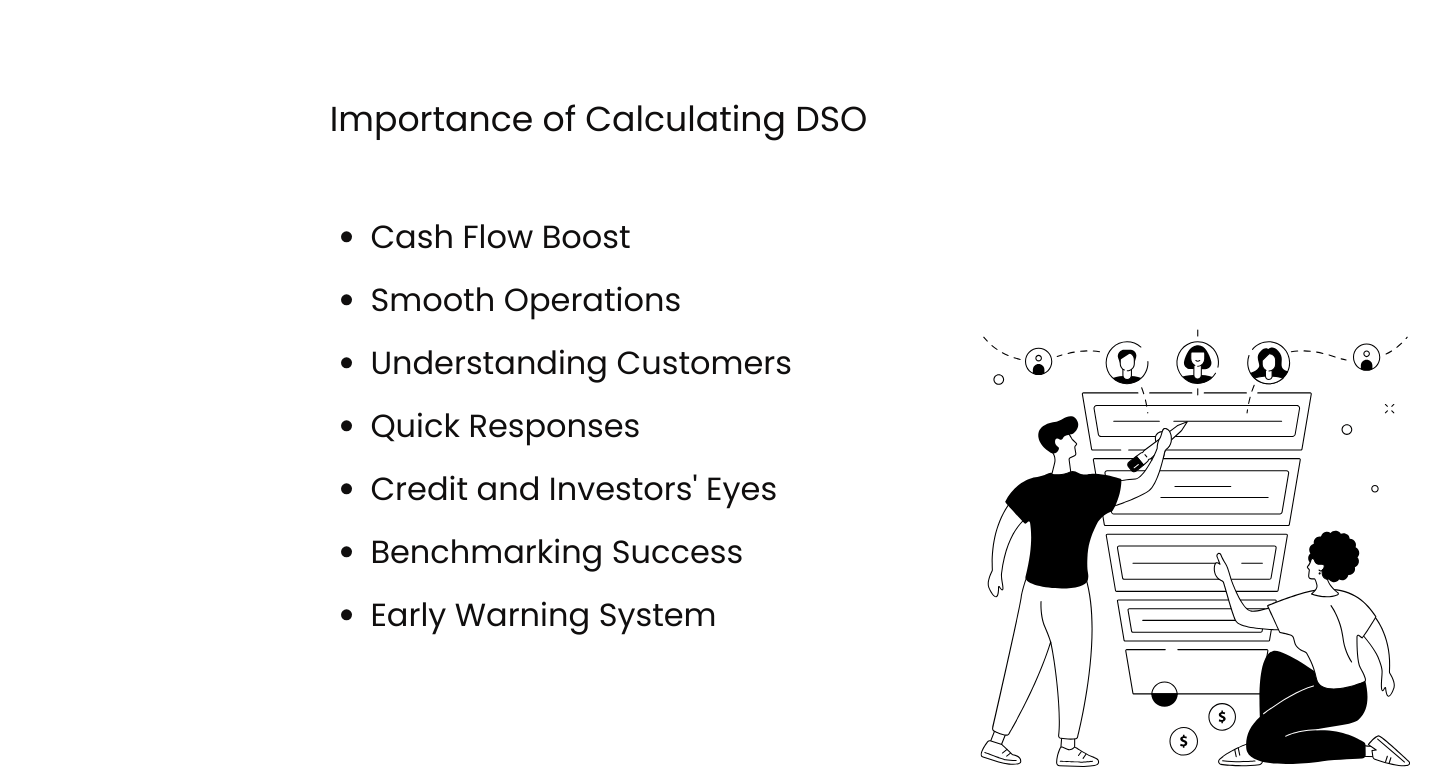
1. Cash Flow Boost
DSO tells you how fast you’re getting paid. A lower DSO means money from sales is rolling in quickly. This gives your business a healthy and predictable cash flow. Think of it as having cash readily available to handle daily needs and seize opportunities.
2. Smooth Operations
Efficient DSO means your working capital (your daily money) stays in good shape. High DSO ties up cash in accounts receivable, potentially limiting your ability to cover immediate costs or invest in growth.
3. Understanding Customers
When you look at it, it is a sneak peek into how your customers pay. Right?
If DSO is high, it could mean your credit policies need tweaking. Or, there might be challenges in collecting payments promptly. Plus, knowing your customers’ payment habits is crucial for maintaining good relationships.
4. Quick Responses
A low DSO makes your business agile. Improved cash flow allows you to make decisions more flexibly and respond swiftly to market changes. It’s like having the agility to jump on opportunities as they arise.
5. Credit and Investors’ Eyes
You get to steal the limelight!
Lenders and investors often peek at DSO when checking your financial health. It’s a snapshot of your business’s creditworthiness. A consistently high DSO might raise eyebrows. It can possibly affect your ability to get favorable financing terms.
6. Benchmarking Success
Compare your DSO to industry standards. If your DSO is way off, it’s like realizing you’re running a different race. Aligning with industry benchmarks helps you stay on track and meet market expectations.
7. Early Warning System
Who wouldn’t like to peek into the future?
(I mean, I would give anything to see your reaction while reading this!)
A rising DSO is like a blinking warning light. It signals potential issues in getting paid. Regular monitoring helps you catch problems early and fix them before they become serious roadblocks.
Implications of DSO on Customer Payment Behavior
Let’s simplify how DSO is like a mirror reflecting your customers’ payment habits and what it means for your business:
Prompt Payment or Delays: If your DSO is low, it’s like customers paying quickly after a sale – Yes, that’s a good sign. But if DSO is high, it might mean delays in getting paid. This hints at potential issues.
Credit Policies Impact: DSO shines a light on how well your credit policies work. A high DSO could mean it’s time to review and adjust your credit terms.
Impact on Relationships: Efficient DSO means smoother cash flow, impacting relationships with suppliers positively. High DSO might strain these relationships due to delayed payments.
Operational Efficiency: A lower DSO contributes to operational efficiency. Swift payments mean less stress on your business to meet day-to-day expenses.
Predictable Cash Flow: With lower DSO, cash flow becomes more predictable. This predictability is a game-changer for planning and making strategic decisions.
Read More: How to Collect Payments from Customers
Challenges Associated with a High DSO
Understanding the hurdles you face, especially regarding liquidity, is essential.
- Delayed Cash Inflow: A high DSO means money from sales takes longer to roll in. This delay can pose challenges in meeting immediate expenses, affecting day-to-day operations.
- Cash Flow Crunch: Prolonged DSO can lead to a cash flow crunch. Think of it like a tap running slower than needed, impacting your ability to invest in growth opportunities or handle unexpected costs.
- Increased Bad Debt Risk: With delayed payments, the risk of customers defaulting on payments increases. This potential rise in bad debt can further strain your financial health.
- Higher Financing Costs: A high DSO might force you to seek external financing to cover operational gaps. This comes with added costs, impacting your bottom line.
- Limited Access to Funds: High DSO can limit your access to funds. It’s like having money stuck in a waiting room, unavailable for immediate use when needed.
- Supplier Relationships: Timely payments to suppliers are crucial. A high DSO may strain these relationships, affecting your ability to negotiate favorable terms or discounts.
- Operational Hurdles: Imagine a conveyor belt moving slower than usual. High DSO introduces operational hurdles, affecting your ability to keep operations running smoothly.
Strategies to Optimize DSO for Improved Cash Flow
The goal is to simplify and streamline the process of receiving payments from customers. Regular monitoring ensures that your business remains adaptable and can fine-tune these strategies.
- Clear Credit Policies: Make sure your customers know your credit terms upfront. Clear communication reduces the chances of payment delays.
- Efficient Invoicing: Send out accurate invoices promptly. Smooth invoicing encourages on-time payments and avoids confusion.
- Payment Incentives: Consider offering discounts for early payments. This gives customers a reason to settle invoices sooner, benefiting both sides.
- Regular Follow-ups: Stay proactive in following up on overdue payments. Regular communication signals the importance of timely payments and helps identify and address issues quickly.
- Leverage Technology: Use invoicing and accounting software to automate processes. Automation reduces errors, speeds up transactions, and makes everything more efficient.
- Credit Checks: Conduct thorough credit checks before extending credit to new customers. Understanding their creditworthiness helps you make informed decisions.
- Collaboration with Sales Teams: Ensure finance and sales teams work together. This alignment ensures a unified approach to credit management, reducing the risk of unnecessary credit risks.
- Customer Education: Communicate your payment expectations and policies to customers. Clarity from the start helps set mutual expectations and reduces payment delays.
- Effective Dispute Resolution: Address and resolve billing disputes promptly. A streamlined dispute resolution process prevents prolonged delays in payment.
- Regular DSO Monitoring: Keep a close eye on your DSO. Regular monitoring helps spot trends and areas for improvement. This allows you to adjust strategies as needed.
In that context, let me introduce how SurveySparrow can complement your efforts. It seamlessly integrates into your workflow, allowing you to gather valuable insights from customers about their payment experiences.
You can optimize DSO and refine your business strategies by combining technological efficiency with customer feedback.
Wrap Up!
Now you know that DSO is your financial pulse. And it guides you toward stability and success. We’ve explored practical strategies, from clear credit policies to utilizing technology, that businesses employ to optimize their DSO.
Moreover, it is essential to monitor it, understand it, and optimize it to ensure a healthy cash flow. It’s not merely a financial strategy. It’s the heartbeat that sustains your business’s growth.
While at it, give SurveySparrow a try. It is free!

Create conversational surveys with SurveySparrow
A personalized walkthrough by our experts. No strings attached!