Knowledge
Volunteer Sampling: Insights, Applications, Advantages

TRUSTED BY BEST-IN-CLASS BRANDS



Volunteer sampling is an approach where participants willingly contribute their thoughts and experiences. It’s like a conversation because only those who are interested in taking part will join. These volunteers eagerly contribute their ideas, perspectives, and stories, adding color to the research. In this blog, we will delve deeper into its meaning, benefits, limitations, and all that you need to know. Whether you are a research guru or a novice in the field, we have something for everyone.
Types of Sampling
Before that, let’s ponder a bit.
What exactly is sampling?
It is selecting a subset of individuals from a larger population. Sampling starts with identifying your population of interest and then funneling it down. This subset will have the characteristics of the entire group.
Now, there are different ways to select these samples. Sampling is broadly divided into probability and non-probability sampling. What are they? Probability sampling methods ensure every member of the population has a non-zero chance of being selected. On the other hand, non-probability sampling methods, like volunteer sampling, do not guarantee equal opportunity for all individuals.
Non-probability Sampling Methods
The best part about non-probability sampling is the flexibility it offers. Here’s a quick overview of some key types:
- Volunteer Sampling: First is our topic of interest. Here, participants willingly contribute their insights. It fosters engagement and openness, making it valuable for various research topics.
- Convenience Sampling: Involves selecting readily available participants for quick data collection. It is often used in exploratory studies.
- Judgmental or Purposive Sampling: It targets specific individuals or groups chosen for their expertise. This helps in providing in-depth insights into the research topic.
- Quota Sampling: This method balances representation by selecting participants from subgroups based on specific characteristics like age or occupation.
- Snowball Sampling: This method explores social networks where initial participants refer to others within their circles. It is helpful to contact hard-to-reach populations.
What Is Volunteer Sampling?
Volunteer sampling is a widely used non-probability sampling technique. But what sets it apart?
Here, participants themselves come up to be a part of the research. Instead of randomly selecting participants, researchers invite individuals who willingly volunteer to participate in the study. It ensures that only those who are interested in the topic come to the forefront. It provides you with valuable data through methods like online surveys, interviews, or questionnaires.
And, regarding surveys, you should consider using advanced tools available in the market. For instance, SurveySparrow will be a great choice if your target is to engage the audience and get more responses. You can create surveys, share on multiple platforms, collate data, analyze it, and act upon the insights you have gained.
Yes, it’s as easy as it sounds! Moreover, you can create surveys using AI and access 1000+ pre-designed survey templates.
Take it for a free spin if you’d like!

Create conversational surveys with SurveySparrow
A personalized walkthrough by our experts. No strings attached!
Example of Volunteer Sampling
For instance, let’s assume you want to explore public opinions on environmental conservation. You decide to post the survey on the social media platforms that you or your company is active in. Here, you are inviting participants to become a part of your survey and share their views voluntarily.
Volunteer sampling thus uses the power of curiosity!
Above all, participants become active contributors, and this makes the method flexible. However, what makes volunteer sampling interesting for me is the unique viewpoints of each participant.
Features of Volunteer Sampling
Now, let’s get technical and look at the key elements.
Remember that:
1. Willing Participation
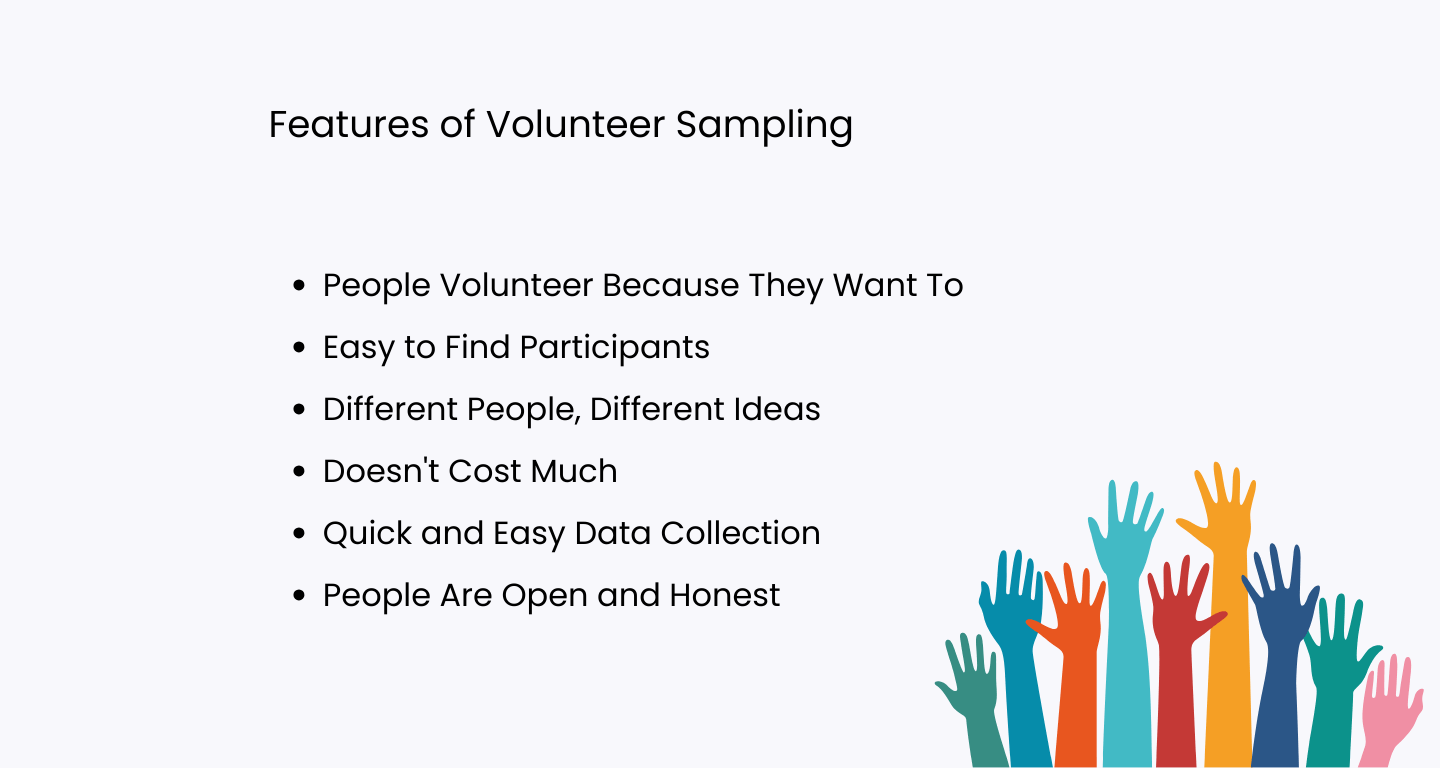
First lies the willingness of participants to actively engage in the research process. Participants choose to take part because they are interested. There is no force here. They willingly share their thoughts and experiences.
2. Accessibility and Convenience
It’s simple to connect with people for volunteer sampling. You can contact them online, on social media, or at events. This makes gathering information quick and straightforward.
3. Diverse Perspectives
Volunteer sampling attracts a variety of individuals. They come from various backgrounds and ages, providing diverse opinions. This diversity helps researchers get a well-rounded view of the topic they’re studying.
4. Cost-Effectiveness
Compared to some other methods, volunteer sampling is budget-friendly. It allows researchers to collect information without spending much money, which is excellent for studies with limited funds.
5. Quick Data Collection and Analysis
Getting responses from volunteers is fast. Researchers can gather information swiftly, allowing them to analyze the data and draw conclusions promptly.
6. Engaged and Open Participants
Volunteers are open and honest in their responses. Because they want to participate, they share their thoughts openly, providing valuable and genuine insights.
When to Use Volunteer Sampling
Researchers opt for volunteer sampling in specific scenarios, such as:
- Primary Research: When exploring a new topic or area, it can provide initial insights. This will guide researchers on the right path for further investigation.
- Limited Resources: In cases where financial or logistical constraints restrict extensive data collection, volunteer sampling offers a viable solution for gathering valuable information.
- Specific Target Audience: When studying niche or specialized groups, volunteer sampling allows researchers to connect with participants with unique knowledge or experiences related to the research topic.
Application of Volunteer Sampling
Now, for those who had a very non-probable chance of coming across this topic (shoutout for still hanging on!), you must be curious about the areas of application.
Let’s look at where all volunteer sampling is widely used:
1. Exploratory Research
- Here, researchers venture into new territories of knowledge.
- When studying emerging trends, social behaviors, or niche interests, this method allows researchers to gather preliminary insights.
- As I mentioned above, curiosity is vital!
- Participants offer unique perspectives. This lays the foundation for more in-depth studies.
2. Pilot Studies and Feasibility Assessments
- Before launching large-scale research projects, researchers often conduct pilot studies or feasibility assessments.
- It helps researchers test their surveys, questionnaires, or interview protocols on a smaller scale.
- Having willing participants ensures the effectiveness and relevance of their methods before diving into extensive research endeavors.
3. Community Engagement and Grassroots Initiatives
- Volunteer sampling connects researchers with local communities.
- It’s vital for grassroots projects, allowing community members to share opinions on programs or services.
- Their input shapes initiatives significantly, ensuring they meet community needs.
4. Niche and Specialized Studies
- Volunteer sampling is essential for specific groups or interests. Researchers target enthusiasts or professionals. This method offers an in-depth understanding of niche topics. How? Thanks to volunteers’ firsthand experiences.
- The power of choice is utilized. With it, researchers can delve deep into the nuances of niche topics, gaining a comprehensive understanding through the firsthand experiences and perspectives of volunteers.
5. Online Platforms and Social Media Research
- Online platforms and social media serve as interaction hubs!
- Surveys and discussions attract interested participants. You get valuable data on online behaviors and trends from this.
- Also, by posting surveys, polls, or discussion topics, researchers attract participants who are genuinely interested in the subject matter.
- Plus, this engagement provides a vast data pool. It is ideal for studies on online behaviors, social trends, and digital experiences.
Limitations of Volunteer Sampling: Challenges to Consider
Sampling Bias: Now, when the participants are random, it is likely that they will have unique traits and characteristics. This can lead to biased results that don’t represent the entire population accurately.
Limited Generalizability: Findings from volunteers might not apply to broader groups. This not only limits the study’s overall applicability but can also indirectly affect its credibility.
Response Bias: Participants might give answers they think researchers expect. There is a high possibility of skewing the data with social desirability bias.
Difficulty in Reaching Specific Groups: Not everyone will be equally interested in participating. Certain groups might not volunteer, making it hard to gather insights from those specific communities or demographics.
Not Suitable for Causation: Volunteer sampling can’t establish cause-and-effect relationships due to its non-random nature. This will also limit the depth of conclusions that can be drawn.
How to Conduct Volunteer Sampling
Though conducting a survey requires planning and specific strategies, it is not as complex as it might seem. (Given that you have a simplified process to guide you)
Don’t worry! Our team has tried to come up with an easy-to-do eight-step guide. Take a look.
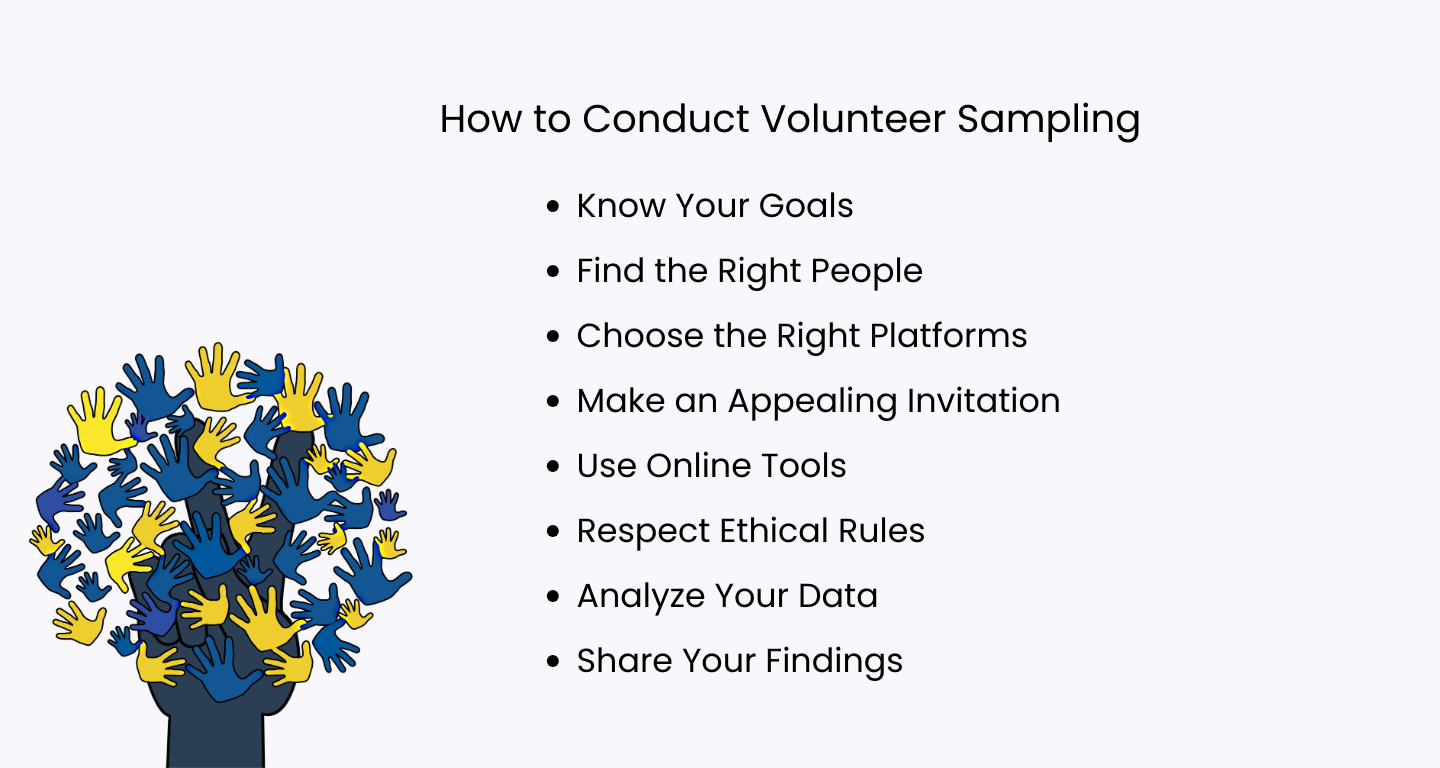
1. Know Your Goals
Clarity is paramount! Be clear about what you want to learn. Define your research objectives so you can focus on finding the correct information.
2. Find the Right People
Identify the specific group you’re interested in. Understand their characteristics and interests. Also, know where they usually hang out, like online communities or social media platforms.
3. Choose the Right Platforms
Pick places where your target group is active. It could be social media, online forums, or local gatherings. Make sure it’s a space where your audience feels comfortable.
4. Make an Appealing Invitation
Create an inviting message explaining your research. Ensure you clearly state why it’s essential and how participants will benefit. Use friendly language to encourage people to join voluntarily.
5. Use Online Tools
Take advantage of online survey tools, such as SurveySparrow, to create easy-to-understand surveys. These tools simplify the process for both you and the participants.
6. Respect Ethical Rules
Always follow ethical guidelines. First, get participants’ permission to participate. Second, explain how their information will be used and kept confidential.
7. Analyze Your Data
Once you collect the data, analyze it carefully. Look for patterns and trends in the responses to understand what people are saying.
8. Share Your Findings
Finally, draw conclusions about your research based on your analysis. Be clear about what you learned and share it responsibly. This must include any limitations you discovered during the study.
Quota Sampling vs Volunteer Sampling
1. Quota Sampling
- Selection Based on Quotas: Here, researchers divide the population into groups based on specific characteristics, such as age, gender, or occupation.
- Specific Numbers: A predetermined number of participants from each group is selected, ensuring representation from different categories.
- Not Voluntary: Participants are chosen based on quotas, regardless of their willingness to participate.
2. Volunteer Sampling
- Willing Participation: Volunteer sampling involves individuals willingly offering to participate in the research.
- Self-Selection: Participants participate out of interest, curiosity, or passion for the topic.
- Flexible and Open: Unlike quota sampling, volunteers are not selected based on specific quotas. Instead, they self-select based on their enthusiasm.
Main Difference
- Selection Method: Quota sampling selects participants based on predetermined quotas, while volunteer sampling relies on participants’ voluntary participation.
- Willingness to Participate: Quota sampling participants are chosen regardless of their desire, whereas volunteer sampling participants actively decide to participate, making the process more open and flexible.
Wrap Up!
Well, voluntary sampling reminds us that every voice matters. It is a way of gaining a more prosperous and inclusive understanding of the world. Its simplicity, cost-effectiveness, and swift data collection make it a valuable tool. Though there are a few inherent limitations, it helps you reach hose corners that were once hard to access.
And before you go, do not forget to give SurveySparrow a try.
Create conversational surveys with SurveySparrow
A personalized walkthrough by our experts. No strings attached!