Knowledge
ANOVA: The Comprehensive Guide to Analysis of Variance

TRUSTED BY BEST-IN-CLASS BRANDS



Have you ever wondered how experts separate signal from noise in a world filled with data? Or perhaps, you might have heard of ANOVA- a term that hints at statistical mastery but leaves you curious for more!
Whether you’re someone who’s wondering “Hey, what is an ANOVA?”, or eager to dive deep into its technicalities, this is exactly the right place. In this blog, we will look into what ANOVA is, when to use it, how to interpret results and so much more.
Let’s start with something for those statistical novices out there. Don’t worry, we’ve got you covered.
What is ANOVA?
ANOVA stands for Analysis of Variance. It is a statistical method used to analyze and compare the means of two or more groups or treatments. It helps us drive meaningful conclusions from our data. How? By allowing us to determine whether there are any significant differences between these groups.
Let’s break it down. Imagine you are a researcher investigating the effect of three different fertilizers on plants. Now, let’s assume we have three different plant groups namely Group A, Group B and Group C. Each of them are going to be treated by differently. This is where ANOVA comes to play. It helps you answer questions like “Is there a significant difference in plant growth between these three groups? Or, is the difference we observe just due to chance?”
ANOVA is apparently your go to tool when there are multiple groups. Especially when you want to know if there’s a real difference in their means.
What is ANOVA Test?
The ANOVA test is often referred to as the F-test. It is basically the core of ANOVA analysis. It is the tool that calculates the variance within each group and the variance between each group. This ultimately provides the F-statistics that allow you to determine if the differences obtained are statistically significant.
Too much huh? Let’s look at it this way. Picture the ANOVA test as a referee in a sports match between teams. The referee closely assesses the performance of each team and evaluates whether any one of them has outperformed the other.
So, what does an Anova test tell you? Here’s how it works:
1. Within-group Variance: Analysis of Variance, as the name suggests, looks at the variation within each group. In our fertilizer example, it assesses how much individual plant growth within each group varies.
2. Between-group Variance: It also examines the variation between the groups. In this case, the tool scrutinizes the differences in plant growth means between Group A, Group B, and Group C.
3. F-statistic: ANOVA crunches these numbers and generates an F-statistic. This F-statistic essentially tells you if the differences between groups are significant or if they could have happened by chance.
The F-statistic, accompanied by a p-value, becomes your compass in ANOVA. If the p-value is below a predetermined level (usually 0.05), you can conclude that there are differences among the groups you’re comparing.
What is ANOVA used for?
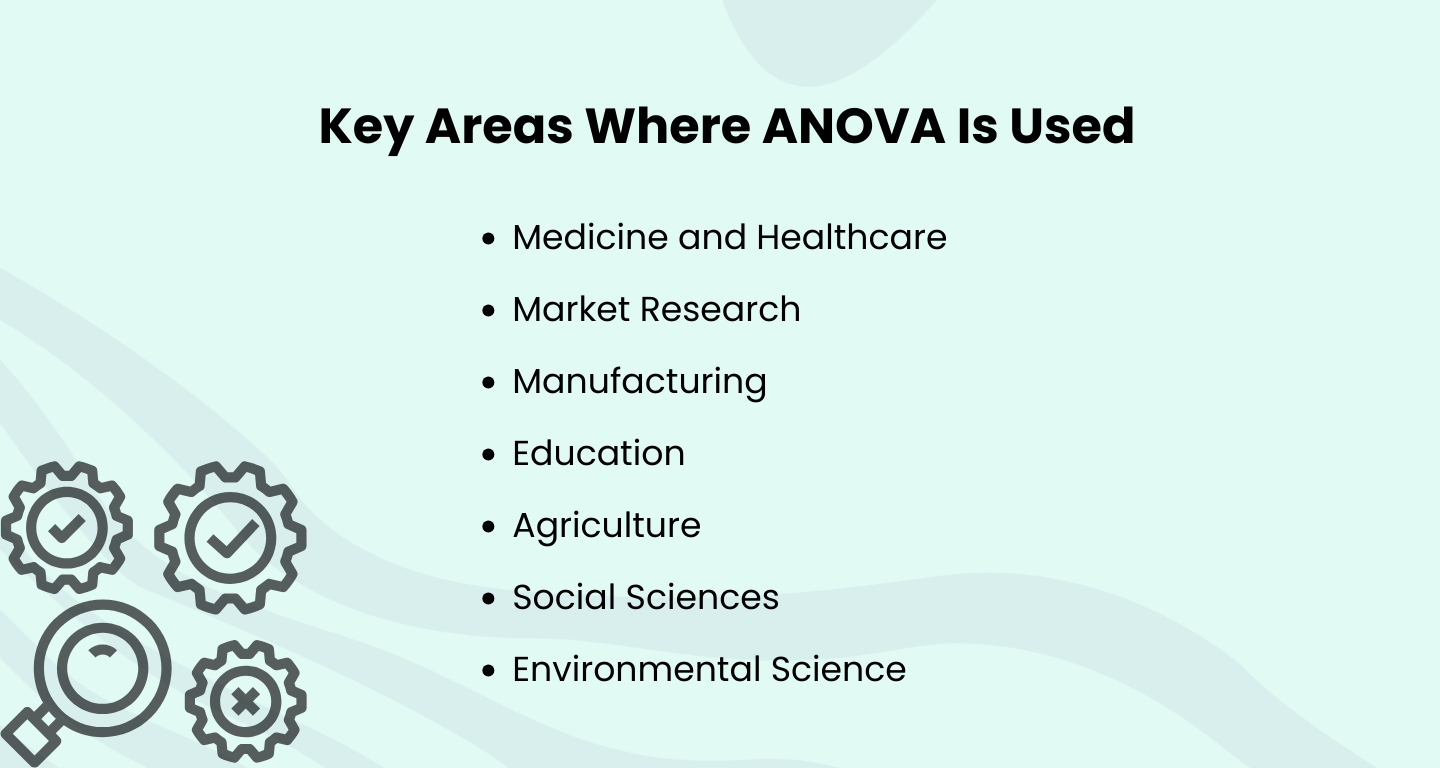
Now that we know what Analysis of Variance is, it is important to understand it’s applications. Here are some key areas where it is frequently used:
1. Medicine and Healthcare
ANOVA helps researchers and clinicians compare the effectiveness of different treatments. For example, it can be used to assess the impact of various drugs or therapies on patients. ANOVA enables medical professionals to make evidence-based decisions when choosing the most effective treatment options.
2. Market Research
Businesses often employ it to evaluate consumer preferences for multiple products or marketing strategies. By analyzing survey data or sales figures, it helps companies identify which products or strategies resonate most with their target audience. This information can guide product development and marketing campaigns.
3. Manufacturing
Quality control is crucial in manufacturing industries. ANOVA plays a vital role in ensuring product consistency and quality. It can be used to analyze data from production processes, detect variations or defects, and make necessary adjustments to maintain product standards.
4. Education
Analysis of Variance is employed in educational research to evaluate the effectiveness of different teaching methods or curriculum changes. Researchers can use it to compare student performance across various instructional approaches, helping educators make data-driven decisions to improve learning outcomes.
5. Agriculture
Farmers and agricultural researchers use it to analyze the impact of different treatments, such as fertilizers or irrigation methods, on crop yields. This allows them to optimize agricultural practices and maximize productivity.
6. Social Sciences
Here the tool is used to study various phenomena, including psychology, sociology, and economics. Moreover, it is used by researchers use to explore differences among groups in areas such as behavior, attitudes, or economic outcomes.
7. Environmental Science
Environmental scientists use ANOVA to analyze data related to environmental factors and their impact on ecosystems. For example, it can be used to assess the effects of pollution levels on biodiversity.
By the way, have you ever come across SurveySparrow? When it comes to collecting the data you need for your statistical analyses, SurveySparrow might be of great help. Our user-friendly survey platform simplifies the process of gathering valuable and rich insights from your audience. With the platform, you can create beautiful surveys, collect responses, and analyze the data—all in one place.
Here comes the interesting part.
How to Use ANOVA
Using ANOVA effectively involves the following steps:
- Formulate your null and alternative hypotheses.
- Collect and organize your data.
- Perform the ANOVA test.
- Interpret the results.
- Make informed decisions based on the findings.
How To Interpret ANOVA Results
Interpreting these results is like deciphering the Da Vinci Code! Okay, that’s a little too much maybe. But, honestly, if you’re a novice in the field, it might take a while before it all starts making sense to you. Once you’ve conducted an ANOVA test and obtained the P-value and F-statistics, here’s how to make sense of what they’re trying to tell you.
1. Understand the F-statistics
- Larger F-value: A larger F-value indicates a greater difference among the group means. It suggests that the variations between the groups are significant.
- Smaller F-value: Conversely, a smaller F-value suggests that the group means are similar, and there may not be significant differences among them.
2. Examine the P-Value
- P-Value < Significance Level (e.g., 0.05): If the p-value is less than your chosen significance level (often set at 0.05), it indicates that there are statistically significant differences among the groups. In other words, you have evidence to reject the null hypothesis, which assumes no significant differences.
- P-Value ≥ Significance Level: If the p-value is equal to or greater than the chosen significance level, you do not have enough evidence to reject the null hypothesis. This suggests that any observed differences are likely due to random chance.
3. Conduct Post-Hoc Tests (if applicable)
- This is applicable only in some cases. When you have more than two groups, and the ANOVA indicates significant differences, you may want to perform post-hoc tests. These tests, such as Tukey’s HSD or Bonferroni correction, can help you identify which specific groups are different from each other. They provide a more detailed view of where the differences lie.
4. Visualize the Data
- Creating graphs, such as box plots or bar charts, can provide a visual representation of the group means and variations. Visualizing the data can make it easier to understand the differences and trends present in your dataset.
5. Consider Practical Significance
- While statistical significance is essential, you must also consider the practical significance of the differences you observe. Ask yourself if the variations are large enough to be meaningful in your real-world context. Sometimes, even if differences are statistically significant, they may not be practically significant.
6. Remember the Null Hypothesis
- Always keep in mind that ANOVA tests the null hypothesis, which assumes no significant differences among the groups. If your results show significance, you’re challenging this null hypothesis.
One Way ANOVA vs Two Way ANOVA
| Aspect | One-Way ANOVA | Two-Way ANOVA |
|---|---|---|
| Factors Analyzed | One | Two |
| Main Purpose | Group Comparison | Factor Effects |
| Example Scenario | Class Comparison | Drug & Dosage |
| Sources of Variation | Within & Between | Within & Between |
| Hypotheses Tested | Equal Means | Main & Interaction |
| Interpretation | Group Differences | Factor Influence |
| Applicability | Single Factor | Two Factors |
One-Way ANOVA:
- Number of Factors: It analyzes one factor or independent variable.
- Main Purpose: Its primary purpose is to compare the means of two or more groups to determine if there are statistically significant differences among them.
- Example: For instance, you might use it to compare the test scores of students in different classes.
- Types of Variation and Sources: One-Way ANOVA considers two types of variation: within-group (variation within each group) and between groups (variation between different groups).
- Hypotheses Tested: It tests the null hypothesis and checks whether all group means are equal.
- Interpretation of Results: One-Way ANOVA helps you determine if there are significant differences in at least one group mean compared to the others.
- Applicability: It is useful when comparing multiple independent groups with one categorical independent variable.
Two-Way ANOVA:
- Number of Factors: It simultaneously analyzes two factors or independent variables.
- Main Purpose: Its main goal is to assess the impact of two independent factors on a dependent variable and whether their interaction significantly influences the dependent variable.
- Example: It assesses how drug type and dosage levels independently and interactively affect outcomes.
- Types of Variation and Sources: Two-Way ANOVA considers variation within each factor (within-group variation for each factor) and the interaction between factors.
- Hypotheses Tested: It tests multiple null hypotheses, including the main effects of each factor and the interaction effect between the factors.
- Interpretation of Results: Two-Way ANOVA provides insights into how each factor and their interaction affect the dependent variable.
- Applicability: It is appropriate when investigating the effects of two independent factors on a dependent variable.
Wrap Up!
That’s about it. We have covered everything you need to know about ANOVA. Starting from what the term means to how it works. Though all those statistics might seem hard to digest (at least for some of us), it is extremely important to gain a competitive edge in the market. Understanding the subtle nuances is crucial for researchers to make informed decisions and derive meaningful insights from the data.
And before you go, why not give SurveySparrow a spin? Perhaps, it is exactly what you’re looking for. You’ll never know until you try!
FAQs
1. How do you solve ANOVA step by step?
- Formulating null and alternative hypotheses.
- Performing ANOVA analysis using software or calculators.
- Checking the F-statistic and p-value.
- Interpreting the results to determine group differences.
2. What is the formula for F-Value in ANOVA?
- The formula for the F-statistic in ANOVA is: F=MSB/MSW, where MSB is the mean square between groups, and MSW is the mean square within groups.
3. What is the ANOVA formula used for?
- The ANOVA formula is used for analyzing and comparing means among three or more groups to determine if there are statistically significant differences.
4. What is the full form of ANOVA?
- ANOVA stands for Analysis of Variance, a statistical method used for comparing means and assessing group differences.