Knowledge
User Feedback: Definition, Importance and How to Collect it

TRUSTED BY BEST-IN-CLASS BRANDS



User feedback is all about what your customers think about you. It’s as simple as that.
But it can also make or break your business! You must understand the meaning, importance, types, and feedback collection methods to stay ahead of the competition.
But don’t you worry! I have covered all this and much more in the simplest way possible—right here!
(A free feedback survey template is attached for you to get a better understanding)
Off we go!
Let’s start with…
What is User Feedback?
User Feedback is the information you gather from your customers about you. It includes opinions, thoughts, suggestions, and any reviews they have about your product, service, or brand.
Knowing that feedback can be positive, neutral, or negative is crucial. This differentiation helps you point out where you excel and which aspects need improvement.
User feedback can be collected through various methods such as surveys, interviews, usability testing, and even social media interactions.
Here is a free sample survey template made with SurveySparrow. This will give you an idea of what it looks like.
(Feel free to customize it if you want! This conversational survey can fetch 40% more responses!)
User Feedback Survey Template
Use This TemplateBefore we move on to the “why,” we need to dig a little deeper into the “what”…
Key Elements of User Feedback
- Voluntary input from users who wish to share their thoughts.
- Focus on customer perspectives by addressing their needs and preferences.
- It is highly subjective and represents individual viewpoints.
- User feedback is available in real time for immediate action.
- It can come in various formats– written, ratings, comments, and reviews.
Now it is time for the why!
Importance of User Feedback
Imagine you launch a product in the market. Now, let’s say you have a handful of customers ready to try it out. They take it home and use it. And then what? You sit and wait. Is that so? No!
This period must be utilized to its maximum potential. You must actively reach out and understand how well (or not) the product is perceived. This is essential for a few reasons. Though the bases are multiple, let’s focus on the vital ones…
- Customer-Centric Approach: It keeps the user as the focus point. This helps a brand discover and segment its target audience and pain points.
- Enhanced UX: By tailoring the service and product with the end-user in mind, you optimize the user experience. After all, our ultimate goal is customer retention, right?
- Brand Loyalty and Trust: Who doesn’t like to feel valued? Your users definitely do! You let them know their opinions matter by actively listening to their feedback.
- Actionable Insights: The responses are not just their thoughts but a detailed outline of what you must do to stay in the business. You have to use the feedback to make informed decisions and improve.
It is always better to go above and beyond! Think outside the box and create strategies that work.
Read More: Importance of Customer Feedback for Product-Led Growth
Types of User Feedback
There are two main types of feedback: Proactive and Passive
| Characteristic | Active Feedback | Passive Feedback |
|---|---|---|
| Initiation | Company-initiated | User-initiated |
| Trigger | Triggered based on business rules (exit intent, click path) | Visible feedback option (feedback button/tab) |
| Purpose | Targeted feedback collection at specific touchpoints | Welcoming general feedback from users |
| Visitor Segmentation | Enables targeting specific user segments or behaviors | Collects feedback from all users |
| Insights | Provides detailed insights into the customer journey | Offers a broader overview of user sentiment |
| Examples | Surveys, interviews, usability testing | Online reviews, social media comments, feedback portals |
| Benefits | Allows personalized feedback collection Captures “in the moment” feedback Enables visitor segmentation and targeted outreach | Demonstrates openness to feedback Keeps negative feedback off public channels Maintains users on the digital path |
1. Proactive Feedback
This is when you take an active approach to seeking feedback. You reach out rather than wait around. Being proactive is beneficial as it helps you identify blind spots, improve performance, and build credibility by acting upon the insights gained.
But again, you need to have a set strategy in action. This involves:
- Having a clear idea of your goals and objectives.
- Choosing a suitable feedback collection method.
- That’s not all! It’s also about choosing the right platform.
- Asking few but precise questions. We need nuanced information, but we can’t risk churn!
- Creating a friendly and open environment.
- And feedback never ends. Track progress and improve every day!
This includes surveys, usability tests, in-app surveys, or email campaigns. We will look into these in detail in a bit.
The most common type of active feedback is an online Survey! They can be NPS, CSAT, CES, or other user experience metrics. With SurveySparrow, all this is possible.
This User feedback tool lets you create conversational surveys, share via multiple channels, and collect feedback. Once the responses flow in, make a detailed report using advanced tools and AI-driven text analytics. Next, visualize the Executive Dashboard data and tackle the issues.
You already saw a sample template. Why don’t you try the other features with a free trial?
Now, active feedback is not the only type…
2. Passive Feedback
Here, you get feedback without nudging your users. Reactive or passive user feedback is essential because it gives insights into customer behavior. You react only upon receiving the responses, whether queries or suggestions.
This involves product usage data, social media mentions, bug reports, complaints, reviews on third-party sites, and support tickets.
User Feedback Metrics
To understand the effectiveness of your actions, there are a few metrics you need to keep track of.
- Net Promoter Score (NPS): This tells you the probability of the number of users who will recommend you to their friends or family. You can know who plans to stay and who is about to churn.
- Customer Satisfaction Score: CSAT measures happiness. With the score, you can also see what you need to improve.
- Customer Effort Score: This tells you the minimum and maximum effort a user exerts while consuming your product or service.
- Retention Rate: This is where you can see the loyalty and trust you built. You can do this by looking at the number of customers who return to you after the first use or visit.
- First Contact Resolution: FCR measures the number of questions answered in the initial contact. This is interesting. Think about it- Would you not be impressed if all your queries were solved in the first go?
- Feature Adoption Rate: How quickly does your user adapt to a new feature? The answer to this question gives you an idea of how effective the product enhancements were.
Other metrics include feedback volume, response time, conversion rate, and churn rate.
Oh, and you can’t forget the open-ended answers. Decode them with sentiment and text analytics.
How to Collect User Feedback?
We already saw the two types of feedback. Why don’t we now look into each of the methods mentioned in them?
First up…
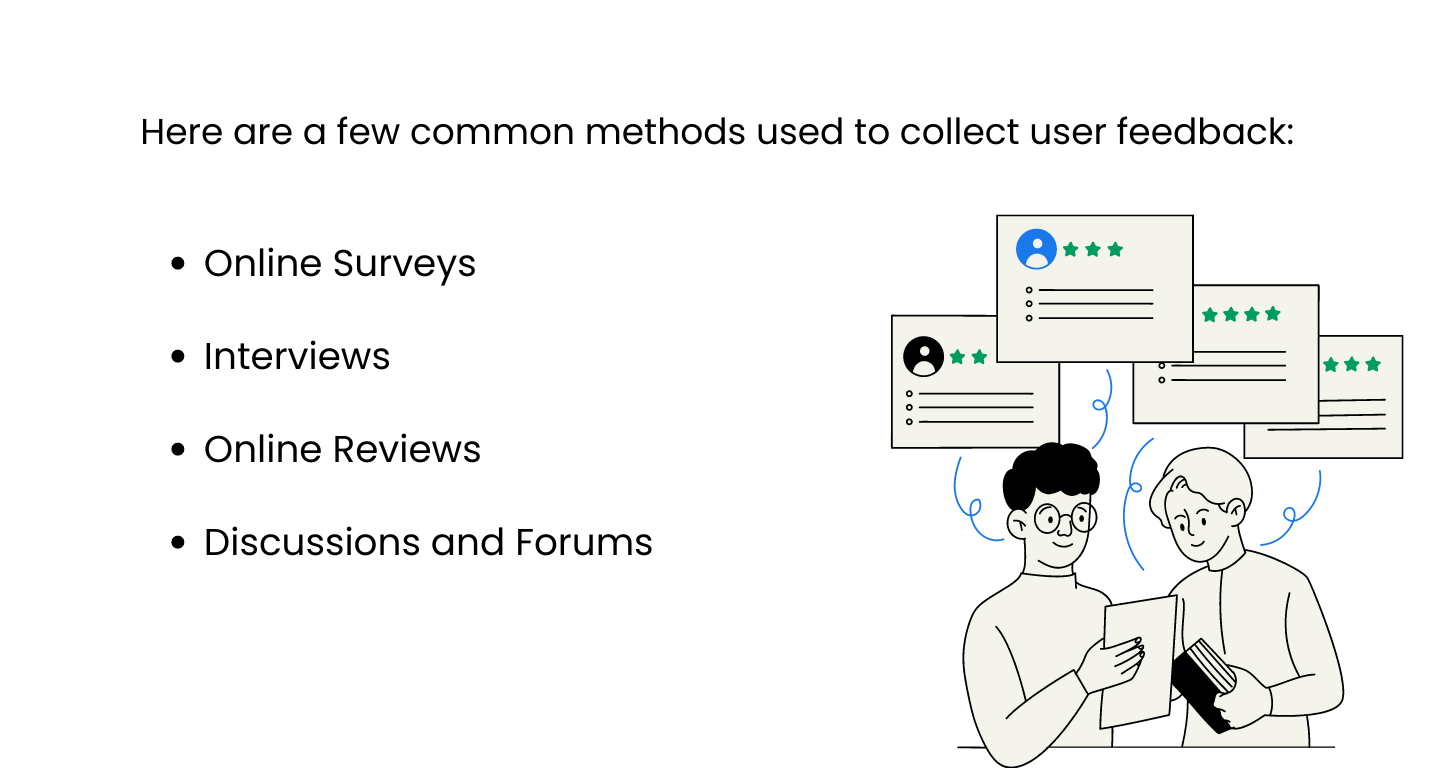
1. Online Feedback Surveys
These can be website surveys, in-app surveys, or email surveys. Online surveys give you contextual feedback, which can be used to enhance your product or service further.
They will help you get a nuanced report on the satisfaction levels, areas of improvement, and where you excel. Plus, you can add open-ended questions to free the users from any restrictions.
Pro Tip!
Mix it up! Use multiple question types, such as Likert scales, opinion and rating scales, multiple-choice questions, matrix, and grid.
Always try to end with Open-ended questions. This allows users to give you unbiased opinions.
2. Interviews
One-on-one interviews help you tackle the issue of distraction. You can take control and hold the respondent’s attention, allowing you to ask tailored questions based on their answers. Now, interviews can be conducted in person or through a phone call.
3. Online Reviews
This is one of the most unsolicited user feedback you can get. Usually, customers share their views about their experience while using your product on a third-party website.
The reviews can be positive or negative. If you observe any review website, you can see that the reviews are from those who have something important to tell to a larger audience (whether showing appreciation, disappointment, or putting out a suggestion)
4. Discussions and Online Forums
Online communities allow your users to discuss you and your offering at an open pace. These forums involve users from various demographics, and conversations are not restricted.
You can openly react to the suggestions and engage with the audience. This will also improve visibility and help you maintain a positive brand image.
Now, there’s one more thing you need to know…
When to Collect User Feedback
Let’s do this based on various touchpoints. This will also make it easier for you to understand.
- Before Launch: This is the early development period. You can identify usability issues and refine product direction.
- During Launch: Once the product is launched, send welcome emails or in-app feedback prompts.
- User Journey: Ongoing user experience can be measured with User satisfaction surveys, feature usage data, social media mentions
- Customer support Interactions: Prompt service is key to a satisfied customer base. Support tickets and live chats can help you understand points.
- Key Actions: This includes post-purchase surveys or addressing service requests.
Common Challenges While Collecting User Feedback
- There might be a Low response rate! Since we all have the attention span of a goldfish, your surveys will probably end up in the trash.
- Poorly designed questions will yield inaccurate and redundant data. Biased wording can also negatively influence the answers.
- You might lose your way in feedback abundance! When you get responses from left and right, it is not easy to differentiate the genuine ones from the spam.
But it’s not that hard to take all these pitfalls if you have the right tool in hand…
User Feedback Collection Tool: SurveySparrow
SurveySparrow can help you collect feedback without any hassle! With the platform, you can:
Create conversational surveys that can fetch you a 40% higher response rate. If you feel a bit lazy, let artificial intelligence take over and create AI surveys with just a hit of a prompt.
Also, there are 1000+ pre-designed survey templates to suit all your needs.
You can embed the surveys into your website by pasting the embed code. No coder’s brain is needed for this! There are multiple other sharing options available.
Once that’s done and the responses arrive, analyze them with advanced analytics tools.
The newly launched text analytics tool CogniVue will help you analyze root causes, find hidden insights, and get a sentiment score based on keyword count and mentions. This makes user feedback analysis as easy as pie!
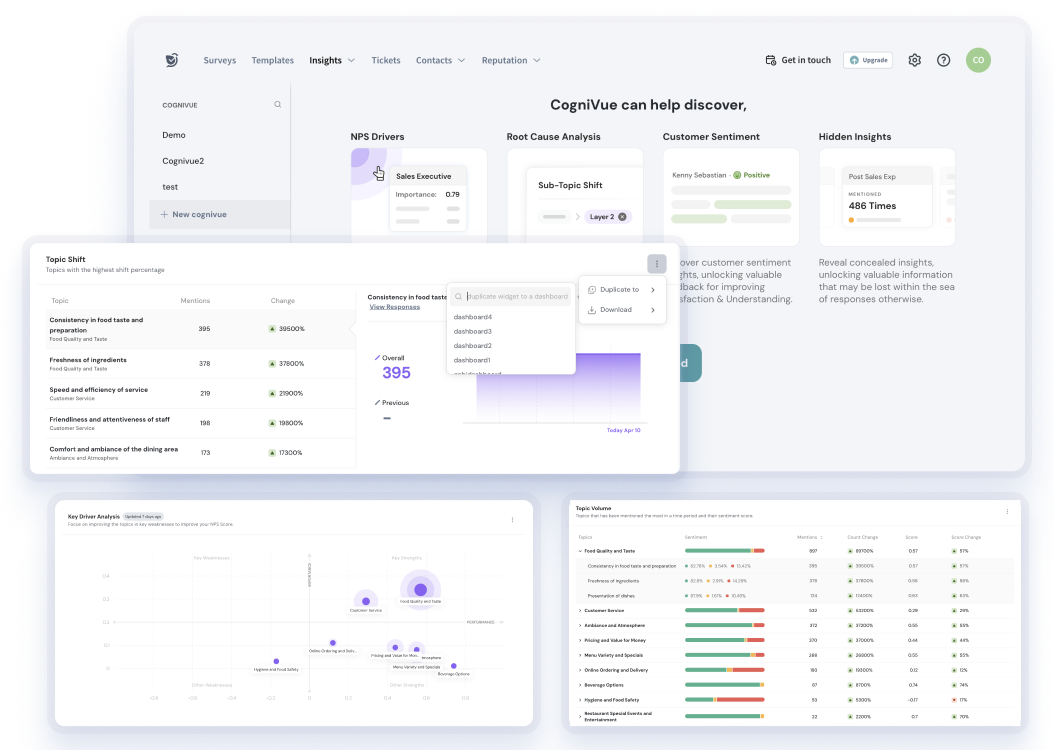
This tool also allows you to assess the topic shift over a set period. With this and the key driver insights, you can identify and work on areas that need immediate attention!
Why don’t you give the platform a try? It’s free!
Wrap Up!
User feedback can’t be ignored. It contains solutions and strategies to tackle customer pain points and improve satisfaction.
By tailoring your brand to user needs and preferences, you put customers at the highest priority. This creates a sense of belongingness and increases customer retention and loyalty.
Make your customer happy every day!
FAQs
1. How can feedback be used to improve product design?
It can identify usability issues, understand needs and preferences, and test new design concepts. The insights you gain here can also improve overall product design.
2. What are some advantages of using surveys for user feedback?
- It will be easier to handle large amounts of data.
- You can collect both qualitative and quantitative data.
- It is also a cost-effective way.
3. How can social media be used as a channel for user feedback?
Social media listening helps you monitor brand mentions and discussions. It also helps you understand user sentiments and identify potential issues.