Knowledge
Probability Sampling: Methods, Examples, Differences, and Insights

TRUSTED BY BEST-IN-CLASS BRANDS



Imagine you want to survey to find out the most popular color from a jar of marble. The jar contains red, blue, pink, and green items. For the sample, you randomly pick the marbles, ensuring that each color has an equal and fair chance. Voila! You just employed probability sampling.
How? Well, in this case, each color represents a unique characteristic within a population. By using probability sampling, you guarantee each color has an equal and fair chance of being selected for your survey. Now, when you conclude that the red marble is the most popular among the lot, you can be confident in the accuracy of your statement. Why? Because it is based on the representative sample of the entire population of marbles.
In this blog, we will look into the methods, steps, examples, and all that you need to know about probability sampling.
Sampling: An Overview
Before we delve deep into probability sampling, it is important to have a strong grasp of the basics.
So, what is sampling? In research, it is the method used to get insights from a huge population. It is the process of selecting a subset, which is called a sample. Sampling ensures that the chosen subset accurately represents and reflects the characteristics of the population of interest. It helps streamline the process of decision-making.
Sampling is broadly categorized into two sub-sections: Probability Sampling and Non-probability Sampling.
Probability vs Non-probability
It is extremely important to understand the subtle differences between the two. Probability sampling provides a solid foundation for researchers to make accurate predictions and informed decisions. Non-probability sampling on the other hand, though not precise, is valuable when it comes to situations where there is a lack of time and limited resources.
For instance, if you have to survey the eating habits of the people residing in California. It is next to impossible for you to go to every individual and collect the information. Right? It is impractical, illogical, and time-consuming. This is where we use a sample to represent the whole population. Now, this sample can be picked either randomly or systematically, using different sampling methods.
What is Probability Sampling?
In Mathematics, probability is the likelihood of an event’s occurrence. It is quantified and expressed as a number between 0 and 1, where 0 refers to uncertainty and 1, is the certainty of it’s happening. When it comes to sampling, it refers to the chance that an individual or an item in a population has to be selected as a part of the subset. Confused, huh? Let’s break it down.
Every day we say that something is likely or something is unlikely to happen. Probability, here, gives us a precise number to give to these guesses. Just think about it, when we say that there is a 50 percent chance for it to pour today, it also means there is a 50 percent chance it won’t, right?
Similarly, in probability sampling, everything and everyone in the population gets an equal and fair chance to be picked. How does it help? It makes it easy to make sense of uncertainty! It helps researchers collect data in an unbiased way to get accurate results.
Probability Sampling Methods
You see when it comes to collating accurate data from a diverse population, probability sampling is the best choice. Many methods can be used to ensure that every member has a non-zero chance of being selected in a sample.
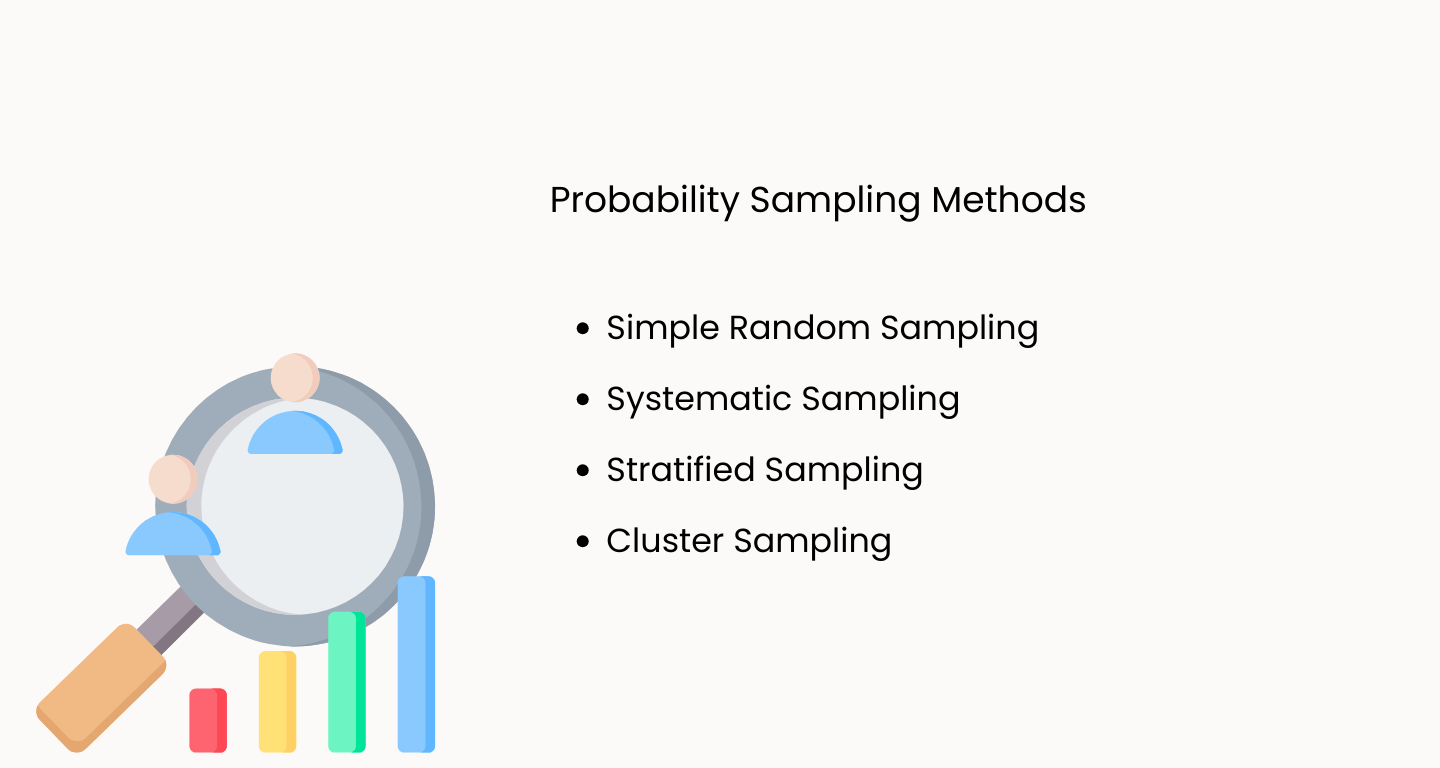
1. Simple Random Sampling
Imagine putting all the items of the population into a hat and picking out a sample without looking. Simple random sampling operates on pure chance. Each member of the population has an equal and independent chance of being selected. This method ensures unbiased representation and is often used in situations where the population is relatively homogeneous.
Let’s assume you’re aiming to understand the preferences of smartphone users in a city. If there are 10,000 smartphone users in the city, assigning each of them a unique number and using a random number generator to select 500 users would constitute a simple random sample. Each smartphone user has an equal chance of being part of the survey, offering a snapshot of the city’s diverse preferences.
2. Systematic Sampling
Systematic sampling involves selecting every ‘kth’ member from a list after randomly choosing a starting point. For instance, if you want to survey every 10th customer entering a store, you could start with a random first customer and then select every 10th person thereafter. This method provides a systematic yet unbiased way of sampling large populations.
3. Stratified Sampling
In situations where the population is diverse and can be divided into distinct subgroups (strata) based on specific characteristics (like age, gender, or income), stratified sampling is the go-to method. Researchers first divide the population into strata and then randomly select samples from each stratum. This ensures representation from every subgroup, leading to a more detailed and accurate analysis.
4. Cluster Sampling
In cluster sampling, researchers divide the population into clusters, like geographical regions or schools. Then, they randomly select whole clusters to be part of the sample. Surveyors interview every individual within the selected clusters. This method is efficient when it’s challenging to create a complete list of the population but easier to group them into clusters.
Each of these probability sampling methods serves different research needs. The key? It is to choose the method that aligns with the specific characteristics of the population and the objectives of the study.
Tools for Probability Sampling
When it comes to the age of the internet, everything is available with just a click. his makes research so much more accessible and efficient. Here are some of the tools that can be used:
1. Survey Software
You can design surveys employing probability sampling techniques. These platforms streamline the sampling process. For instance, SurveySparrow lets you create engaging surveys, collect data, and analyze and act upon the insights that are derived from them. Utilizing advanced platforms not only makes it time-effective but also enhances efficiency and accuracy.
2. Random Number Generators
Online random number generators are of great help for simple random sampling. Researchers can generate a list of random numbers corresponding to unique identifiers in the population. These numbers then determine the selected individuals or items, ensuring a truly random sample.
3. Geographic Information Systems (GIS) Software
Such tools enable researchers to conduct stratified sampling based on geographical regions. By overlaying population data on maps, researchers can visually analyze the population distribution and create strata for more targeted sampling.
Pros and Cons of Probability Sampling
Advantages
- Representativeness: It ensures that the sample mirrors the entire population, leading to results that are applicable in a wider context.
- Unbiased Results: Since it is based on chance, it avoids sampling bias. It enhances the reliability of the data.
- Generalizability: The accurate representation lets you generalize the findings. This means that the conclusions that are drawn from the sample can be extended to the entire population.
- Precise Statistical Analysis: The known probabilities for each member of the sample allow statistical calculations.
Limitations
- Need for Complete Population List: A comprehensive list of the entire population is necessary to conduct probability sampling. This can be a little challenging in certain cases.
- Resource-Intensive: In cases where you are dealing with a large population, it can be time-consuming and requires a lot of effort. You might also need a lot of monetary back-ups to facilitate the study.
- Complexity in Implementation: Methods such as stratified or multistage sampling, might be complex to design. you need adequate training and expertise to make it work.
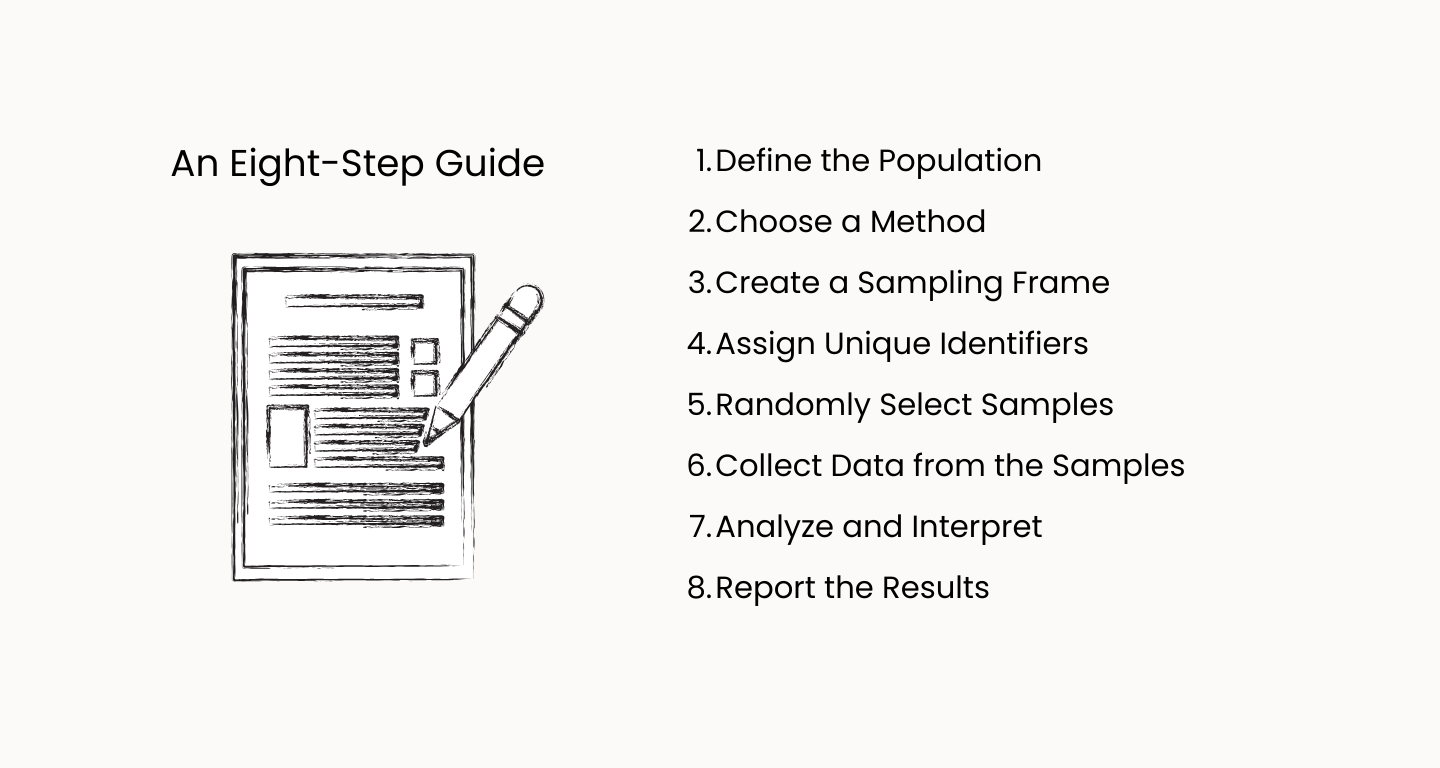
How to Conduct: An Eight-Step Guide
By now, you might have understood that probability sampling is not a walk around the park. It is a meticulous process that demands precise planning and execution to avoid misrepresentation. But worry not, we have curated a step-by-step guide on how to conduct it.
#1 Define the Population
Clearly define the target population. This requirement needs to be detailed and specific, outlining the characteristics and boundaries of the group. Clarity is key!
#2 Choose a Method
Choose according to the nature of your study and the characteristics of your population. Remember that the choice of methods should align with your research objectives.
#3 Create a Sampling Frame
Create a list containing all the elements of your population. This is called a sampling frame. Why is it important though? Because it forms the basis for selecting the sample. The frame should be up-to-date and accurate
#4 Assign Unique Identifiers
Add distinct numbers or codes to each element in the frame. They play a crucial role in the selection process, ensuring that every element has a fair chance of being chosen.
#5 Randomly Select Samples
This selection should correspond to the unique identifiers you assigned to the elements. These random numbers guide the selection of samples. For example, if you’re employing simple random sampling, you can use a random number generator to pick specific numbers, indicating the selected elements.
#6 Collect Data from the Samples
Collect data through surveys, interviews, observations, or any other data collection method relevant to your research. Double-check for consistency and accuracy throughout.
#7 Analyze and Interpret
Use appropriate statistical techniques for this. Researchers can use the results from this analysis to conclude the entire population. Plus, you must ensure that they are valid and reliable.
#8. Report the Results
Communicate the results through presentations, reports, or academic papers. You must clearly outline the method used, the sample size, the frame, and the limitations encountered during the sampling process. Transparency in reporting is crucial to ensure credibility.
Conclusion
Though probability sampling might sound complex, its essence is simple. What’s that? Fairness!
Whether delving into societal trends, market behaviors, or scientific phenomena, the accuracy of probability sampling helps in informed decision-making. Moreover, probability sampling isn’t just a technique. By understanding and using probability sampling methods, researchers can learn about people and the world. This helps them make important decisions that can change things for the better. It’s like having a special tool that ensures that we make smart choices.
And, before you leave, why not give SurveySparrow a try?