Brand Experience
Conversational Support: Definition, Tips and Software Features

Article written by Parvathi Vijayamohan
Content Marketer at SurveySparrow

9 min read
4 June 2024


Brand Experience
Article written by Parvathi Vijayamohan
Content Marketer at SurveySparrow
9 min read
4 June 2024
Research shows that 55% of businesses that use conversational support and marketing receive higher quality leads. Additional reports by Juniper Research endorse this, showing that voice and chat technologies are projected to bring in $290 billion in sales by 2025.
In other words, conversational customer support will be vital for your customer support transformation.
In this article, we’ll:
It’s the phrase used to describe a customer service strategy that relies on messaging apps and chatbots to communicate with customers.
Conversational support is different from traditional customer service in a few ways:
One of the indispensable elements of conversational support is omnichannel messaging.
This means that customers should be able to reach your company through various channels, including SMS, email, social media, chatbots, and live chat. By offering multiple channels, you’ll make it easy for customers to get in touch with you however they want.
That said, what are the differences between omnichannel and multichannel support? Let’s find out.


Chatbots can be a powerful tool for conversational support. They can automate routine tasks, like answering common questions or routing customers to the right person.
Chatbots can also help you qualify leads and gather customer information. When used correctly, chatbots can free up your team’s time so they can focus on more complex tasks.
74% of customers would rather use a chatbot to answer simple questions.
Another way to use chatbots is to automate replies to common questions. This can be helpful if you find that you’re answering the same questions over and over again.
By automating these replies, you’ll be able to provide a quicker response time, keep ticket backlogs to a minimum, and enable self-service on the part of the customer.
Using chatbots, you can also use filters to qualify the customers and prospects. For example, you can set up a filter to only allow chats from people who live in your country or have made a purchase within the last six months. By using filters, you’ll be able to focus on the most qualified leads.
Take, for example, our work with The PowerMBA, a startup that offers online MBA programs with the collaboration of top entrepreneurs like the founders of Netflix, YouTube, and Spotify.
Using SurveySparrow, ThePowerMBA has seen a 15% spike in lead captures and saved around 300 engineering hours.
Conversational support software like SurveySparrow gives you access to customer records and chat history. This data can help personalize messages and each follow-up because it includes information like the customer’s name, location, purchase history, and more.
By personalizing each message, you’ll be able to build deeper relationships with your customers. What’s more, chatbots and chat message templates (like the one below) can help you deliver fast, personal support without radically increasing your cost per customer interaction.
Customer Satisfaction Survey
Use This TemplateWhile chatbots can help automate rote tasks, it’s important to use a mix of chatbots and human support. In this hybrid mode, chatbots handle high volume-low value requests, while human agents handle escalation requests.
With this, you’ll be able to provide your customers with 24/7 support and the best possible experience. In addition, it is possible to establish a smooth escalation process by using omnichannel support software as they come equipped with ticketing features.
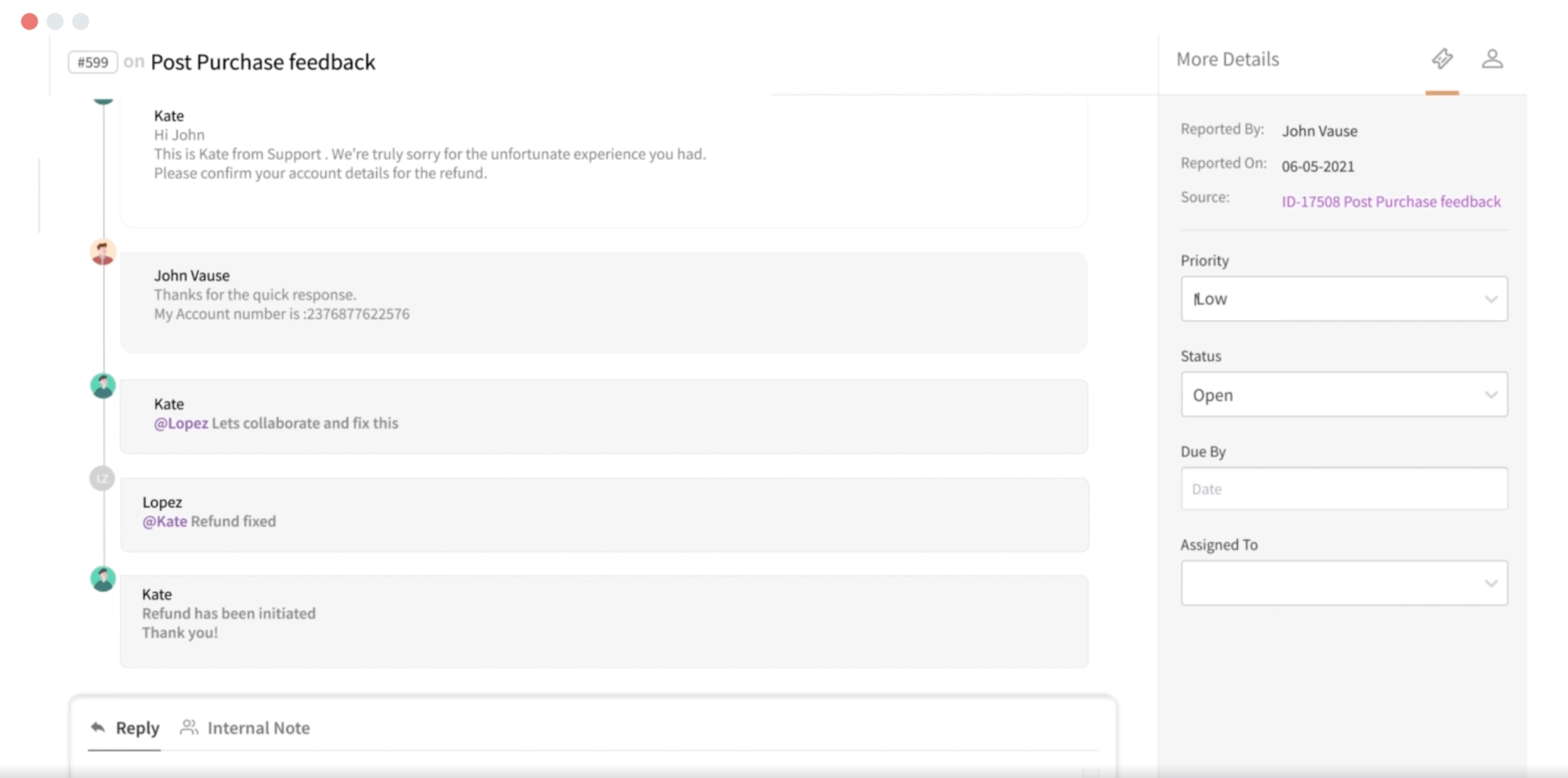
Sometimes, solving a customer issue is not as straightforward as Customer -> Support. For example, depending on the nature of the query, other teams need to be looped in, like Sales, Insurance, Billing, etc.
Regardless of what’s happening backstage, the customer does not want to know that they are being dragged from Support to Sales or Billing to IT for an answer.
Conversational support simplifies this customer flow. With conversational software, you can immediately assign the customer to the relevant contact.
If you’re using conversational support, you can also combine it with conversational marketing. For example, you can program chatbots to share targeted messages and personalized offers to customers based on specific triggers, like user replies.
By combining these two strategies, you’ll be able to increase customer engagement and set up potential sales funnels with half the effort.
If you find that customers often wait for a long time to speak to someone, you can gamify the process. For example, you can use a chatbot to quiz customers while waiting or, like Google, a fun little game where they can score reward points.
Another technique can be offering customers reward points or special discounts for using self-service channels or help articles instead of live support. By gamifying the process, you’ll be able to keep customers engaged and reduce wait times.
Conversational survey software comes with an all-important feature: dashboards. They help you visualize data, but how do you use them?
As we had explained above, conversational support is a treasure trove of information. This data helps you:
Dashboards make this data easy to understand and track. They can also help you present this data to team members without ever touching a spreadsheet.
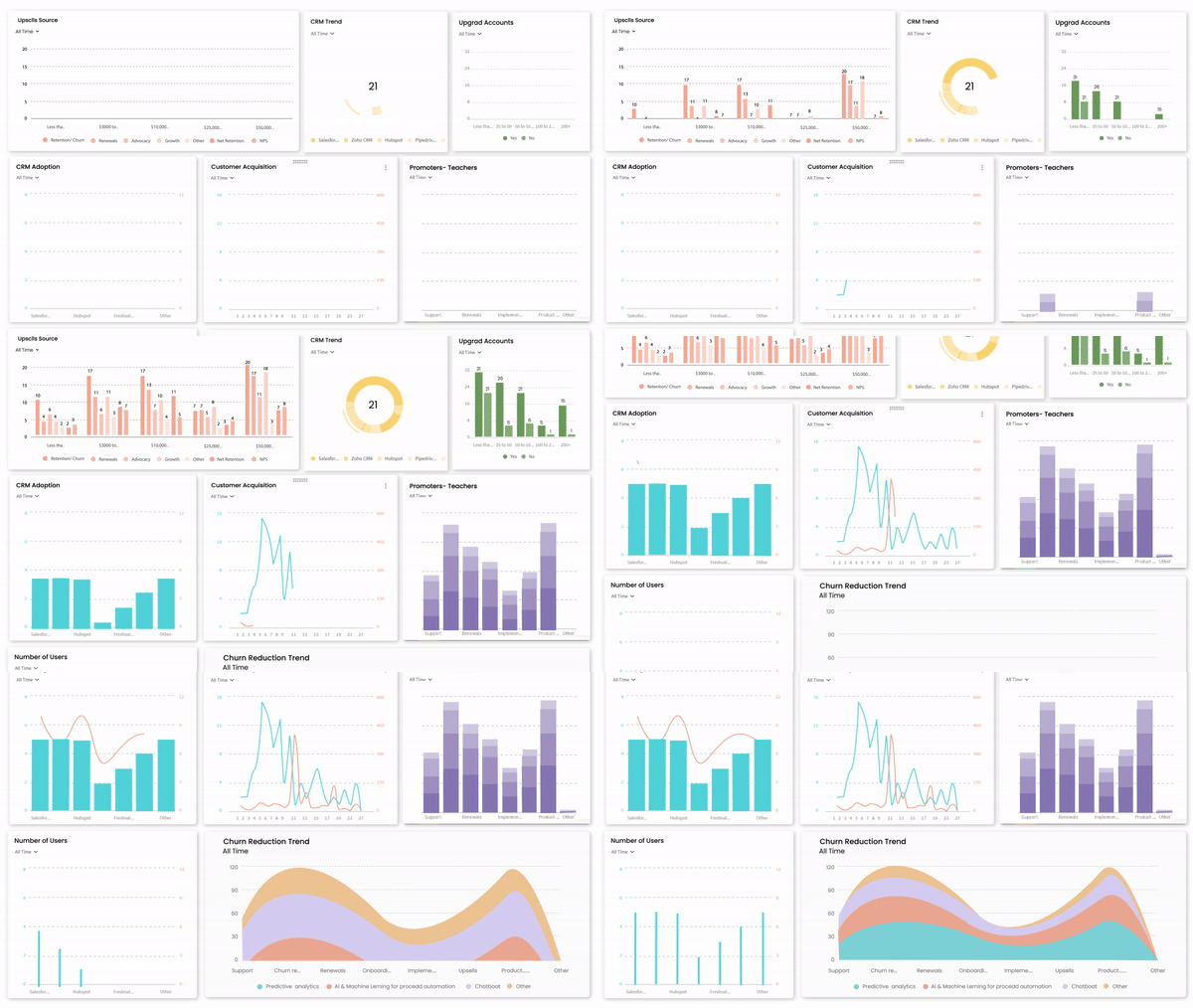
Customer sentiment analysis can be a helpful way to improve conversational support. This analysis can help you understand how customers feel about your company and your products.
By understanding customer sentiment, you’ll be able to make changes to improve the customer experience.
Conversational engagement software or support software is a type of software that helps you deliver a smooth customer journey by serving as a unified platform for customer experience. They come with the following features:
In this article, we’ve covered the definition of conversational support, along with tips to implement conversational support for your business. Moreover, we’ve also listed the features you need to look for when investing in a conversational support software.
Need some more pointers on how to set up conversational support for your business? Then check out:


Thousands of brands trust SurveySparrow to turn feedback into growth. Try it free today!

Brand Experience
15 MINUTES
6 July 2018

Best Of
12 MINUTES
12 November 2020

Best Of
15 MINUTES
24 May 2021

Best Of
13 MINUTES
4 June 2021


