Customer Experience
Types of Customer Feedback: Importance, Benefits and Examples

Article written by Kate Williams
Content Marketer at SurveySparrow

15 min read
24 April 2024


Customer Experience
Article written by Kate Williams
Content Marketer at SurveySparrow
15 min read
24 April 2024
Don’t you think strong communication lays the foundation for any successful business? Understanding the different types of customer feedback is crucial to building that ground!
The good news is that a whole world of insights is waiting to be discovered. This blog will look into the different types of feedback and all that you need to know about them.
(I’ll also introduce you to a customer feedback collection tool so you can put what you learned into practice immediately!)
Off we go!
Let’s start with…
Customer feedback is the experience a customer shares about a particular product, service, or brand.
It is greatly needed to understand the satisfaction levels and areas for improvement. I mean, what are we without our customers? A brand must understand its audience’s needs, preferences, and interests to create experiences that last a lifetime!
Plus, feedback reveals the loyalty factor. By analyzing the reviews and answering them promptly, you can understand who will stay and who’s about to churn!
Customer Feedback comes in various forms. Based on customer sentiment, it can be broadly categorized as constructive, positive, and negative.
You know how vital it is to manage feedback at each touchpoint, right? An advanced Reputation Management tool such as SurveySparrow will be handy. With the platform, you can convert your customers from consumers to brand advocates!
Curious about how?
Well, we’ll talk about the tool in detail later. Let’s get back to addressing the elephant in the room.
There are two main categories that you need to understand before we go deeper- Active Feedback and Passive Feedback.
This can get a tad bit lengthy for you. Feel free to jump ahead to the type of your choice:
This is the most common and significant type of feedback. These responses are the insights a brand gathers directly from the customers after they roll out a survey. These surveys are structured and designed to gather feedback on products and services.
They measure customer experience, satisfaction levels, and preferences.
Now, these cons can be easily solved with an advanced online survey tool. All you need is a conversational UI to chat with your audience. With SurveySparrow, you can create engaging forms that reap 40% higher responses! No more skewed results.
Plus, sentiment analysis lets you decode open-ended questions and turn them into actionable insights!
Here is a sample template for you to get a feel of a customer feedback survey.
(Hey, feel free to use or customize it if you like. More than 1000 other templates are waiting for you to personalize them. Check them out as well when you get time!)
Customer Feedback Survey Template
Use This TemplateNow, it’s time to move on to the next one.
Do you ever receive surveys asking for your rating after using a mobile app or ordering food? These are in-app surveys that help companies get real-time feedback.
With these reviews, you get a detailed idea of user experience. By strategically placing surveys at key touchpoints, brands can easily identify challenges and improve accordingly.
You must respond to all reviews promptly, whether positive, negative, or constructive. It’s always good to thank users for their time. The next step is to address the negative reviews and make the required changes.
Above all, constructive feedback can help you improve your app by analyzing recurring themes and fixing the reported bugs for a better user experience.
Read More: In-App Surveys: The Complete Guide with Sample Questions
They are requests raised by the customers for new functionality, improvement, or addition to a product or service. These requests are most often the desires or wishes of your audience and, hence, give you a comprehensive idea of their preferences and interests.
Now, the requests can be raised and submitted through various channels, including customer support tickets, website feedback forms, dedicated forums, or within the product itself.
They must be prioritized based on demand, strategic alignment, and technical feasibility.
Like any other case, a response must start with appreciation for the time your customer invested in you. Further, acknowledge the feasibility of the request and prioritize it. Update them on whether a feature is under consideration or in development.
Also, be transparent if some cannot be implemented at the moment. Answering every customer request might sound far-fetched, but it is key to building trust in your audience.
Net promoter score is calculated using an NPS survey. They are a quick way of measuring customer satisfaction, typically with a single question. It asks the respondents how likely it would be for them to recommend their product or service to a friend or family member.
Based on the scores, customers are categorized into:
NPS = Percentage (%) of Promoters−Percentage (%) of Detractors
Segment the responses into promoters, passives, and detractors. Then, close the loop by addressing each section. This projects your commitment.
Also, remember to track your score over time and use an NPS benchmark for continuous improvement.
Read More: The Beginner’s Guide to Benchmark your NPS
CSAT Surveys are used to get a score that tells how happy or unhappy customers are with the brand, product, or service. These consist of questions designed to gather feedback on various aspects of customer experience.
You can tailor these surveys to your needs and preferences. Plus, you can qualify the data for analysis and trend detection by using rating scales and multiple-choice questions. (Always couple it up with an open-ended question to understand why they feel that way)
CSAT (%) = (Number of Positive Responses / Total Responses) x 100
You should analyze the data, focus on the recurring themes and trends, and make room for improvement. Yes, I know I have repeated the next point quite a few times, but I can’t put enough stress on it. It is crucial to close the loop and not leave anyone hanging.
Whether you want to create engaging CSAT, NPS, CES surveys, embed an in-app survey, manage feature requests, close the loop, or analyze the trends to make informed decisions, SurveySparrow is here to help!
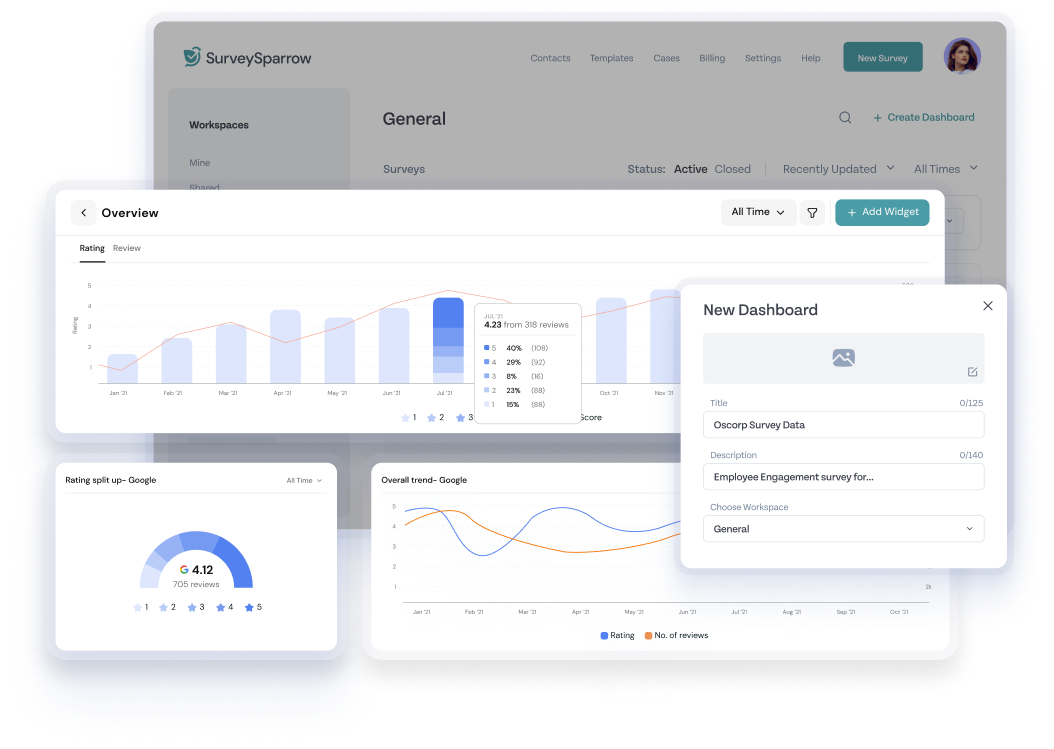
Try the platform once for free and see for yourself! A 14-day free trial will tell you if it perfectly matches your needs.
Now let’s look at…

Passive feedback is the reviews customers give without being nudged by the company or brand. The customers themselves initiate it, and it is, hence, organic.
Some of the most common types include comments on social media, online reviews on third-party sites, customer behavior analysis, online forums, brand mentions, and website analytics.
These might seem irrelevant, but they hold high weight when measuring brand image and value.
Have you ever left a comment on your favorite brand’s social media pages? These comments give a company insights into customer thoughts and preferences and, like any other feedback mode, help them improve products or services.
While authenticity might be an advantage, the comments can be overwhelming. You’ll have to put added effort into segmenting the relevant ones and then further into negative, positive, and construction ones.
Again, review and reputation management platforms will help you streamline the process.
Online reviews are comments posted by customers on third-party sites.
This can be on other review platforms or e-commerce sites. Many of us might have added our reviews under a product we liked after a purchase on Amazon. Right? (Or, perhaps, when dissatisfied)
These online reviews can be positive or negative and give businesses an idea of brand perception. Again, you must respond to both without fail. Apologize for the inconvenience caused to the customer, and clearly outline the measures you’re willing to take to resolve the issue. In case of good reviews, show appreciation for the feedback.
The thing is, customers often compare products based on the reviews on these sites. So they can break or make your brand image.
Online forums allow customers to share their experiences, thoughts, and product ideas. They interact with fellow customers, making it a safe space for in-depth discussions.
The best part? They facilitate long-tail feedback, unlike other platforms that allow only short reviews. It is like a peer-to-peer support platform where customers help troubleshoot issues.
By monitoring relevant forums, brands can get a detailed overview of where they stand in the market. Also, they can participate in the discussions by addressing concerns and answering questions.
This is where your brand, product, or service is mentioned online. Note that this is done regardless of the official context. These mentions can be on any online platform, such as blogs, forums, or review sites.
For instance, have you seen product review bloggers mentioning some of their preferred tools in their write-ups? That’s what we’re talking about.
Brands can use social listening tools and methods like volume tracking or influencer identification to determine by whom and how much their name has been referred. Upon doing that, proactively take action based on the type of feedback shared on these platforms.
Though subject to bias, this type of feedback helps increase brand visibility.
These are widgets that are embedded in apps or websites. It is a non-intrusive way for customers to share their opinions and thoughts about a brand or product. These widgets can be triggered and customized based on the use and time intervals.
These widgets are embedded as a pop-up, in the sidebar, or as a button. The main goal is to keep it somewhere that doesn’t disrupt user experience.
Also, remember to tell your users when you implement a suggested change and show that you’re listening.
That’s about it! We have converted the ten most important types of feedback that you should know clearly about.
Now you need to know…
You can improve products and services by collecting and acting upon customer feedback. This helps create a positive customer experience, leading to customer retention and loyalty.
Focus on customer feedback, take action, and build lasting relationships. While at it, use SurveySparrow to streamline the entire process. This might be the tool you’ve been looking for all this while.
Try it for free today!
1. How do we Address Customer Feedback?
Here’s a simple process:
2. What is feedback Looping?
It is the continuous process of collecting, analyzing, visualizing, and implementing customer feedback to drive improvements and enhance customer experiences.
3. What are the best practices to follow for managing customer feedback?


Thousands of brands trust SurveySparrow to turn feedback into growth. Try it free today!


Customer Experience
11 MINUTES
29 August 2022

Customer Experience
9 MINUTES
29 May 2024

Best Of
13 MINUTES
4 June 2021

Customer Experience
10 MINUTES
31 August 2023

