Best Of
Defining Survey Goals and Objectives: A Quick Guide

Article written by Pragadeesh Natarajan
pragadeesh

10 min read
11 June 2024


Best Of
Article written by Pragadeesh Natarajan
pragadeesh
10 min read
11 June 2024
Survey goals and objectives are important because they help you ask the right questions, obtain useful answers, and achieve the best results.
How do we know?
Because setting goals and objectives is the first step in our template creation process, and we’ve experienced all of those benefits firsthand.
In this article, we’ll:
Ready? Let’s get started. You can click to jump ahead to the section that interests you.
Your goal is the primary aim of your survey. It’s a broad statement that explains the purpose of your survey and what you’re looking to achieve with it.
You need answers from a group of people, and your goal conveys why you need to get those answers from this group of people.
An objective is a specific step or action that would help you achieve your survey’s goal. Often, there will be multiple objectives for a single goal statement.
For instance:
Goal: “To understand why our customers churn”.
Why should you begin by setting a goal for your survey? Why not jump head-first into asking a bunch of questions?
Before you can ask questions, you need to know how you’d use the answers. How are you going to put the data to use?
The answers you gain from your survey are only useful if you have a clear idea about how you’d use them and the actions and decisions you’d take with them.
A survey goal explains the purpose of collecting the data through your survey. Once you know the goal you want to accomplish with your survey, you get a clear idea about what you want to learn. And when you’re clear about what you want to learn, it gets a lot easier to come up with the right questions you’d want to ask your audience.
When the survey’s purpose is clear, you’ll:
As you can see, setting goals and objectives is the essential first step in conducting a successful survey.
The second step is choosing the right survey software, because you will get access to 1000+ survey templates for different survey goals, like market research, bestselling products, website usability, etc.
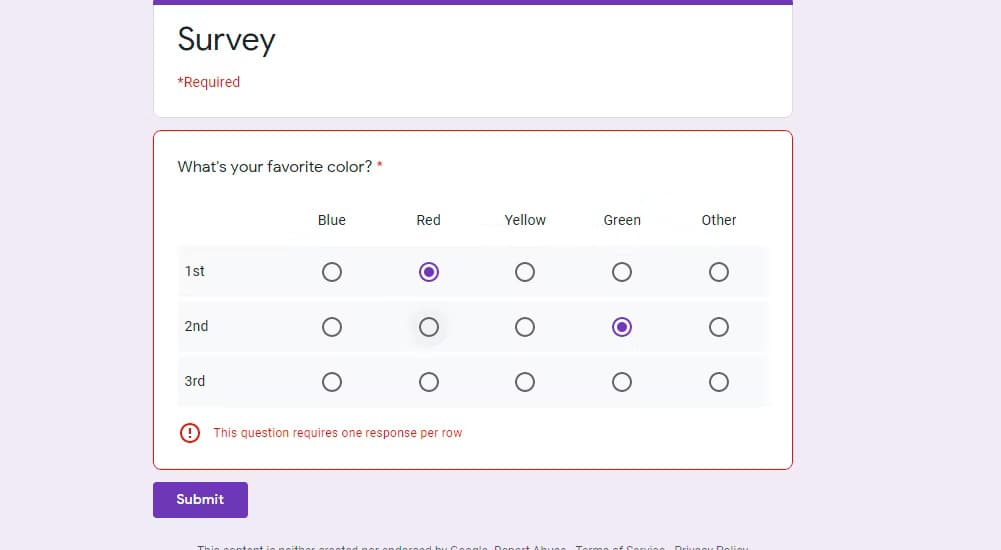
Here’s a quick survey created using SurveySparrow.
You can create a free account to get 14-day unrestricted access to our enterprise survey software.
To create such surveys, sign up for FREE here.
Setting goals and objectives can be quite confusing. Here are a few questions you can ask yourself to define goals and objectives for your surveys:
What is it that you need feedback or opinion about?
For instance, the subject or topic could be an experience — say, your users’ onboarding or purchase experience — your product or service, a functionality, your brand, an event, etc.
Now that you’ve nailed the subject of your survey, you need to know what you want to learn about the subject. Ask yourself: what am I looking to learn?
For instance, you might want to learn about your customers’ satisfaction with your product, or you might be looking to determine the effectiveness of your landing page copy.
Once you’re clear about the subject and what you’re looking to learn about it, the next step is to identify who you’re looking to learn that from.
Think about the target audience you’d be reaching out to for opinions about the subject. The people you need answers from. The people who’d provide you with the right set of answers.
The key is to narrow down on a specific customer segment that would provide you with accurate information.
What are you looking to achieve with the answers that have been provided to you? How would it lead to you improving, understanding, or determining something?
For instance, you might want to validate if there’s a need for a solution because you’re looking to solve an unmet need and develop a better offering for a specific customer segment.
If you’re finding it hard to develop goals and objectives for your surveys, you can follow a simple framework to write effective goal statements.
A. Start your objective or goal statement with the word to, followed by an action verb such as improve, measure, assess, validate, investigate, explain, explore, identify, and so on.
For instance, “To determine how satisfied customers are with a new functionality”, “To identify what motivates our ideal customers to choose us over our competitors”, “To inform us on how many items we need to procure this quarter”, etc.
B. You can then come up with relevant objectives based on your goal statement. Once you have the objectives required to attain the survey’s goal, you can put together a list of questions needed to achieve those objectives.
Now that you know what survey goals and objectives are and how you can define them, let’s take a look at some common survey goal examples you can take inspiration from to define your own.
2. The common employee survey goals:
3. A business executive looking for feedback regarding:
4. A startup or an SMB owner looking to understand:
Objectives help you ask the right questions, get the correct answers, and make the survey process so much easier. Here are a few best practices you can follow to define clear objectives for your survey:
Your survey objectives should follow the specific, measurable, achievable, relevant, and time-bound (SMART) rule.
You need to conduct thorough research on the subject of your survey. When you have a firm grasp of the survey’s subject, you can write insightful questions that help you achieve your survey’s goal. For instance, if you’re a marketing manager, and you’re looking to conduct a survey, the subject of your survey could be:
That said, keep in mind that most information is inherently biased and not trustworthy.
Once you’re done writing the goals and objectives for your survey, review them a few times. Make sure everything is clean and organized.
After you’ve reviewed it for flaws, ask a colleague to critique it. They can provide you valuable feedback on how you can improve them and help you spot any holes or mistakes that you might have missed.
Also, before you start distributing your survey, run a survey pilot. Select a small group of respondents from your target group and ask them for their feedback and ideas. Doing this will help you identify any issues or vague questions in your survey.
Before you can write your questions and gain insights, you need to be clear about why you need to gain those insights.
When you’ve defined clear goals and objectives, you make sure that the data you collect is worthwhile, valid, and accurate.
Got any questions on setting survey goals and objectives? Any interesting tips or techniques you use to define clear goals and objectives for your surveys? Let us know about them in the comment section below.
Looking to create conversational surveys that people love answering? Feel free to check out SurveySparrow


Thousands of brands trust SurveySparrow to turn feedback into growth. Try it free today!


Best Of
15 MINUTES
23 May 2020

Best Of
11 MINUTES
21 February 2021

Best Of
7 MINUTES
16 October 2021
Best Of
10 MINUTES
25 July 2022
14-day free trial • Cancel Anytime • No Credit Card Required • No Strings Attached

