Knowledge
Snowball Sampling: Techniques, Applications, Examples

TRUSTED BY BEST-IN-CLASS BRANDS



What’s research? It is the systematic process of investigating, analyzing, and interpreting information. Why? To discover new facts, validate existing theories, or solve specific problems. If you are familiar with the term, you might have heard about qualitative and quantitative research. Now, if you delve a little deeper, you’ll come across sampling and its two types: probability and non-probability sampling. (No, we’re not done yet!) Go further into the non-probability sample, and you’ll land on snowball sampling!
In this blog, we will zoom in on this sampling method, exploring its types, applications, and everything in between.
What is Sampling?
Sampling in research is like randomly choosing names from a phone book or drawing lots to select a winner at a community event. It’s about picking a more minor group from a big one. This is what makes research doable.
This subset, which represents the entire population of interest, is called a sample.
So, why is it so important?
Just imagine surveying a few “billion” people for your research. Impractical, right? That’s just why sampling is essential. By examining a smaller group, researchers can learn important things without overwhelming themselves. It helps them make accurate conclusions.
This is where you should take the help of advanced online survey tools. Surveys help in data collection. If you’d like, consider SurveySparrow. The platform lets you create engaging surveys, share them on multiple media, collate data, analyze it, and act upon the valuable insights gained. Yes, you heard me right. All this is possible on one platform.
Why not take it for a spin?

Create conversational surveys with SurveySparrow
A personalized walkthrough by our experts. No strings attached!
Types of Sampling: Probability and Non-Probability
In research, there are two types of sampling: probability and non-probability.
- Probability Sampling: It ensures everyone in the group has an equal chance of being chosen.
- Non-Probability Sampling: This type relies on specific criteria and personal judgment. It is more subjective.
Non-Probability Sampling: Explained
Non-probability sampling is a method where not every participant in the population has an equal chance of being selected. As we mentioned above, it relies on specific criteria and personal judgment. There are several methods under non-probability sampling. Here are some common ones:
- Convenience Sampling: Choosing people who are easy to reach. e.g., those nearby or available at the moment.
- Judgmental or Purposive Sampling: Selecting participants based on the researcher’s judgment. e.g., experts or those with specific knowledge.
- Quota Sampling: Dividing the population into groups and selecting participants from each group. This continues until a set quota is met. e.g., choosing a specific number of people from different age categories.
- Snowball Sampling: Starting with one person and growing the sample as participants refer others. It creates a chain-like effect.
What is Snowball Sampling?
Snowball sampling is a research method used to study a population that is hard to reach. Imagine you’re collecting snowflakes. It starts with one, and you let it roll downhill. On the way, you pick up more snow. Snowball sampling works a bit like that, but in research. It provides a methodological snowball effect where the sample size gradually expands.
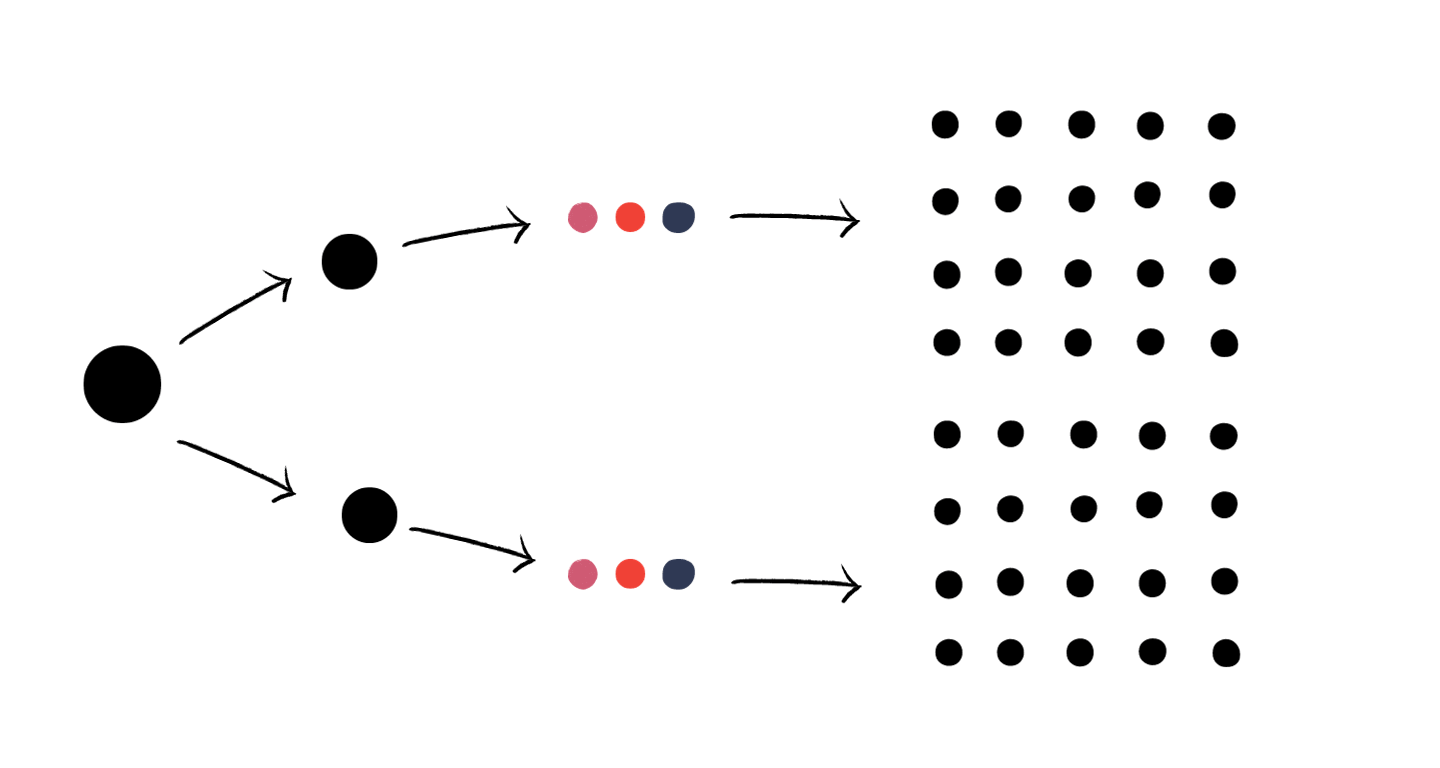
How It Works:
- Start Small: Begin with a single participant, often someone with unique access or knowledge about the group being studied.
- Expand Through Referrals: After interviewing the initial participant, ask them to refer others who meet the study criteria.
- Chain Effect: Each new participant refers to more individuals. This creates a ‘snowball effect’ that enlarges the sample size over time.
It is useful when researching a sensitive topic and the participants are reluctant to participate.
Now, are we clear with the basics?
(Note: For those research gurus out there, we were all novices once, right?)
Let’s get to the interesting part and dive into the intricacies of this sampling method, shall we?
Types Of Snowball Sampling
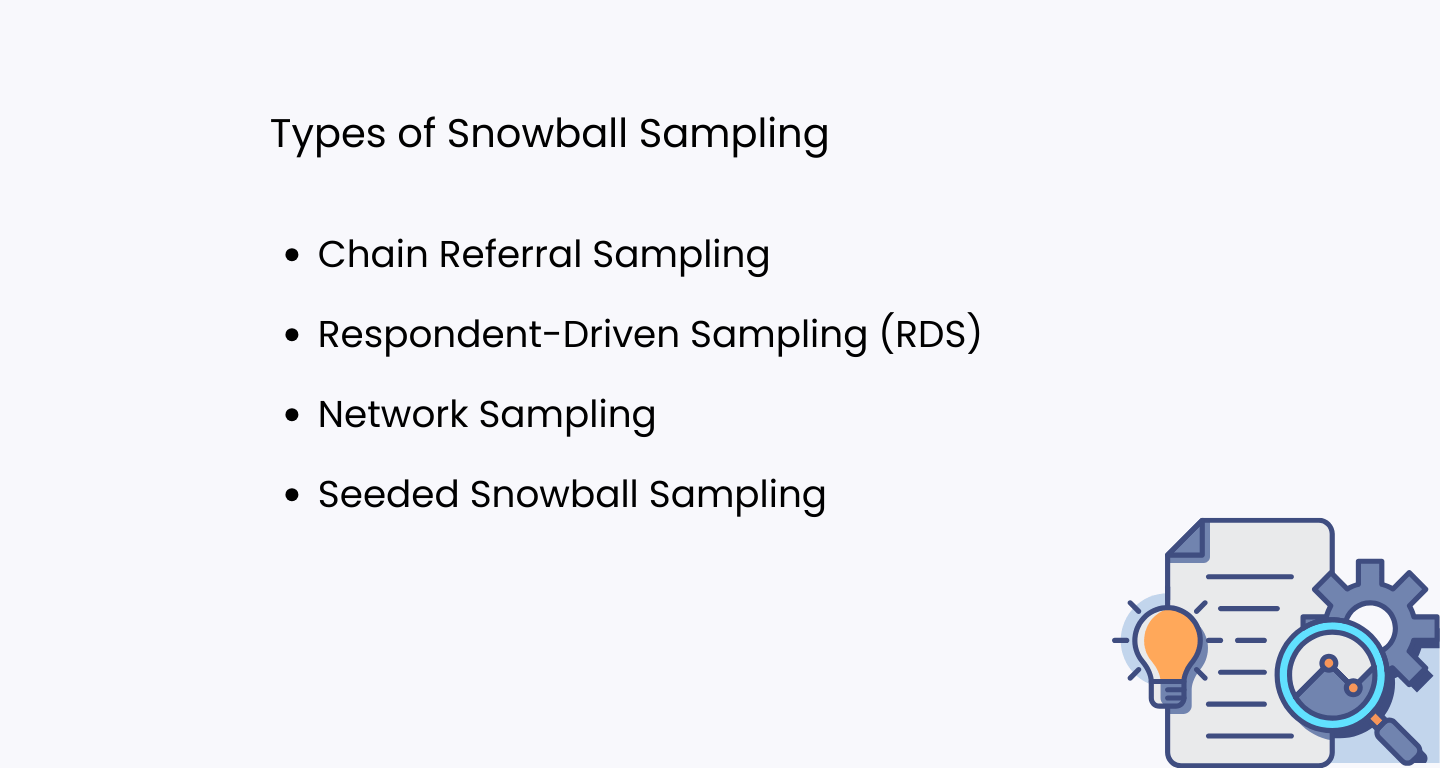
There is so much more than meets the eye regarding snowball sampling. It is also called “network,” “chain referral,” “respondent-driven,” and “seeded” sampling. Each of these techniques (if I may) has unique characteristics and perspectives. Have a look at them:
1. Chain Referral Sampling
In this, participants refer to others sequentially. This creates a chain-like structure (thus the name!)
- It is simple and straightforward. This is one reason why it is comparatively easy to implement.
- Where is it used? It is effective when you try to study communities that have a clear social structure. Moreover, it encourages participants to participate in the referral process actively.
- Use it in instances where building a network is your aim. e.g., exploratory research
- What makes it effective is that it allows you to race the referral path. This helps you understand social connections better.
- In fact, what makes it interesting, I believe, is the natural flow it offers. It resembles real-life interactions.
- Remember that it is only suitable when the participants are comfortable referring others.
Moving on to the next method, RDS.
2. Respondent-Driven Sampling (RDS)
RDS combines elements of snowball and probability sampling. (And, you attain a perfect balance)
- It enhances data accuracy. How? Participants provide information about their social networks.
- Sampling biases are corrected by using statistical techniques. This also improves sample representativeness and enhances reliability by minimizing selection biases.
- It provides a systematic method for determining participant incentives.
- Chiefly, the method enables researchers to calculate sample weights. This ensures data analysis.
- It creates a sense of trust in the participants. Wouldn’t you love to be promised confidentiality and privacy?
3. Network Sampling
Just as the name suggests, network sampling refers to a method that works on the foundation of building connections.
- It focuses on entire social networks. Mainly, it studies interactions and relationships.
- So, what does this study offer? A holistic view of community structures and social dynamics. This also helps you get a bird’s eye view of the top influencers within the community.
- It also gives an idea of the interconnectedness of the participants.
- Go for this method if you’re planning to study information flow. Moreover, it gives you command over the patterns within networks.
- Now, where is it used? It is often used in sociology and anthropology studies to analyze social relationships.
4. Seeded Snowball Sampling
Before we start on this one, you need to understand what a seed is in snowball sampling.
So, a seed is like the initial domino in a row. You get what I mean? Let me explain.
Snowball sampling begins with one or a set of participants. A seed is the initial participant(s) of that lot. It is the one who begins the chain. Got it?
Now, let’s get back to where we started.
Seeded snowball sampling allows you to control the initial participants. This helps in maintaining specific characteristics or expertise.
- If you wish to focus on specific subgroups within a larger community, this method is for you.
- The best part is that it provides a structured approach to building a participant network.
- We all know how important it is to get the perfect beginning. Seeded snowball sampling ensures a consistent starting point for the sampling process.
- As we discussed earlier, it helps balance inclusivity and specificity in participant selection.
- Basically, you have control over the direction of the sampling process. You become the helm and the seeded sampling, the ship. (Poetic much?)
Snowball Sampling User Base
Now comes the question: who uses snowball sampling?
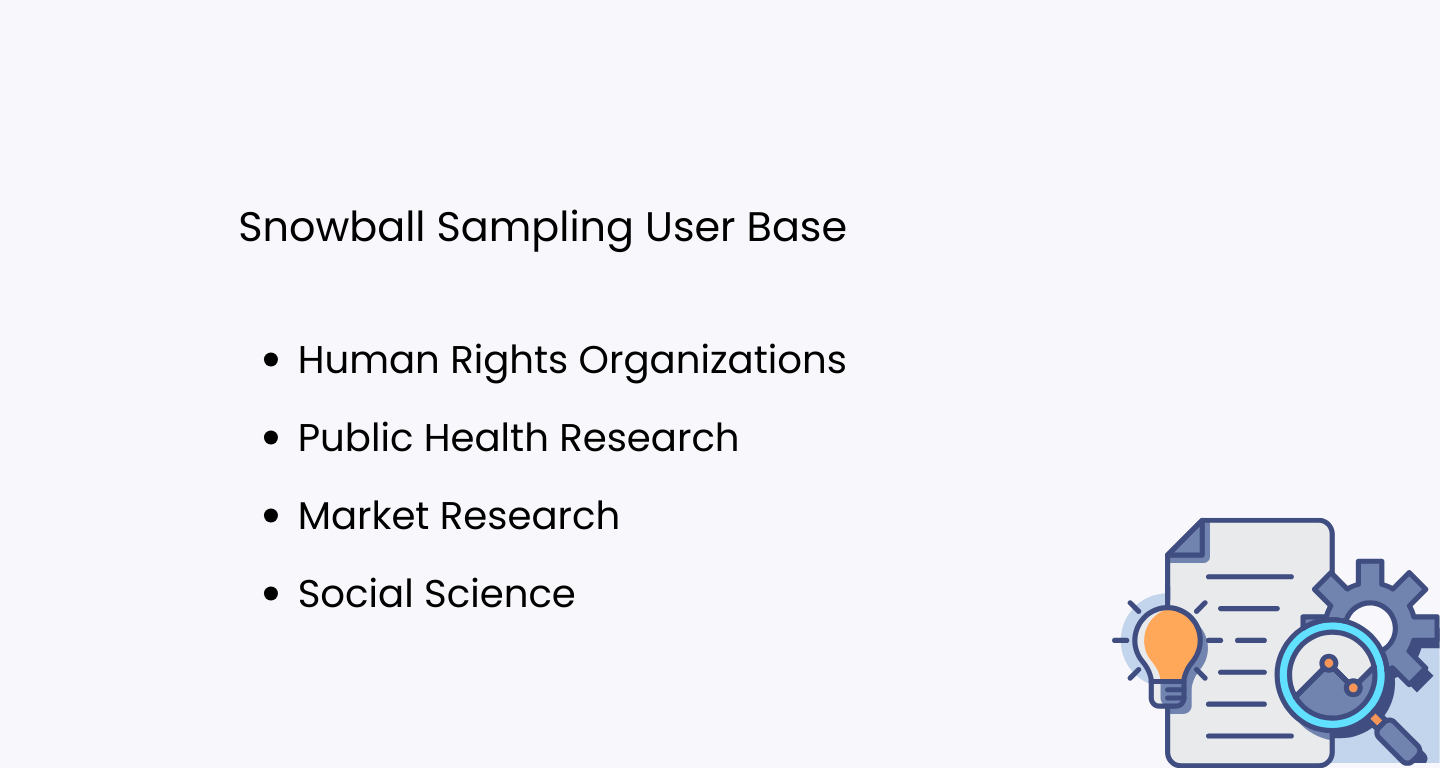
It isn’t restricted to specific fields. What makes it unique is its adaptable nature. Snowball sampling has a diverse user base. Let’s take a look at a few of them:
1. Human Rights Organizations
Human rights organizations rely on snowball sampling. It helps to gather firsthand narratives of human rights violations. This enables them to advocate for the right cause. This method strengthens their policy influence by providing concrete data. Apart from that, it supports legal actions.
Snowball sampling also educates the public about community challenges. Additionally, the data collected empowers affected communities by giving them a platform to share their stories.
Moreover, it supports the efforts of long-term change by exposing recurring human rights issues.
2. Public Health Research
Snowballing helps in understanding disease transmission behaviors. This enables the growth of targeted development strategies.
It reveals disparities in healthcare access. How? By highlighting areas needing intervention and investment.
It supports epidemiological studies. This collection helps in future health education initiatives. Plus, it helps in providing data for vaccine research. This method is beneficial when you are trying to study less-known diseases.
3. Market Research
Market research is one of the most important aspects of a company’s growth. Sampling here helps to provide insights into consumer behavior. It also helps in identifying distinct consumer segments for targeted marketing.
What intrigues me is its ability to analyze competitors effortlessly. Moreover, it predicts market trends. This helps you make informed decisions. That’s a catch, right?
4. Social Science
As I mentioned before, snowball sampling helps to break down social dynamics within communities. It helps you study social movements, identities, and community development efforts.
The best part? It supports identity studies. It helps you delve into the depth of gender, ethnicity, and social identity within communities.
How to Do Snowball Sampling
Here are a few things you should do:
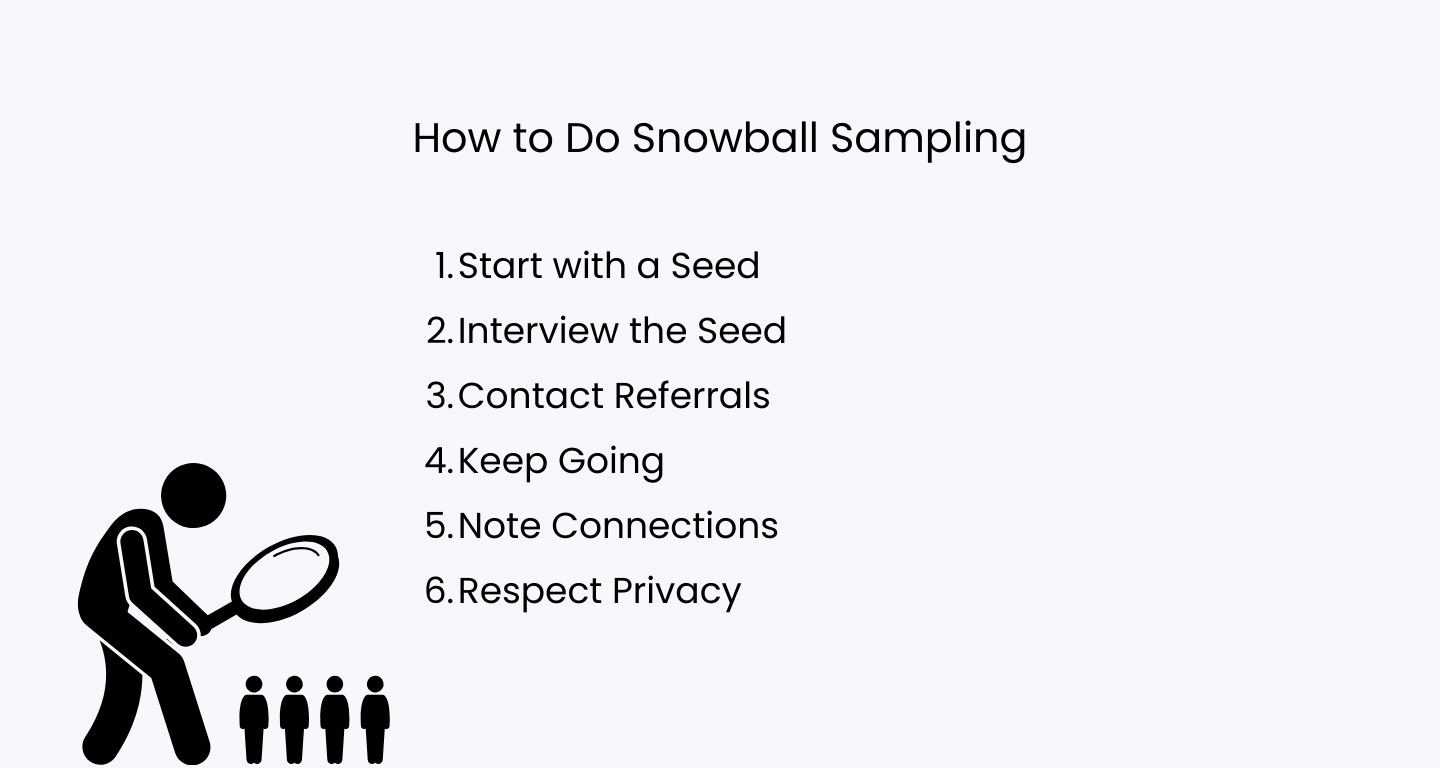
- Start with a Seed: Begin with someone you know in the community. This person can introduce you to others.
- Interview the Seed: Talk to the Seed. Understand their experiences and ask for referrals. They will recommend other community members who might be relevant to your study.
- Contact Referrals: Reach out to the referrals and interview them too. During these interviews, ask for more referrals. This chain continues like a snowball rolling and gathering more snow.
- Keep Going: Keep talking to new people and collecting referrals until you have enough participants for your study. Each person you interview leads you to more potential participants.
- Note Connections: Note connections between the people you interview along the way. Understanding the relationships within the community helps in analyzing the data.
- Respect Privacy: Always respect people’s privacy. Ask for their consent before including them in your study. Make sure they understand the purpose of your research.
Importance of Snowball Sampling
Snowballing helps in expanding the scope of research. Here are a few points I think we should all consider:
- Reaching Hidden Communities: Snowball sampling helps find people who are usually difficult to locate or talk to.
- Building Trust: People prefer to talk if someone they trust introduces them.
- Rich, Diverse Data: It gathers information from many different people, giving a wide view of the topic.
- Exploring Sensitive Topics: It makes it easier for people to talk about sensitive or private issues.
- Community Insight: Helps understand how communities work and how people are connected.
- Flexible and Cost-Effective: Saves Money! It’s a low-cost way to gather information compared to other methods.
Advantages of Snowball Sampling
Snowballing does not come without advantages. What are they?
- Easy Access: First of all, it helps researchers reach people. Even those who are not easily accessible through traditional methods.
- Trust and Comfort: Participants feel more comfortable talking when introduced to someone they know. This builds trust in the research process.
- Diverse Perspectives: It gathers various opinions and experiences. Further, it provides a broader understanding of the topic.
- Cost-Effective: Snowball sampling is budget-friendly as it relies on existing social networks.
- Flexible: It adapts well to different communities and situations. Also, it makes it fit for various research needs.
- Exploring Sensitive Topics: Lastly, participants find it easier to discuss sensitive issues in a familiar and trusted environment.
Limitations of Snowball Sampling
Now that you understand the pros let’s look at some cons:
- Limited Selection: Snowball sampling might leave out important individuals.
- Not Random: People are not chosen randomly, leading to potential bias.
- Inaccurate Results: Findings might not represent the entire community accurately.
- Privacy Concerns: Some may not share personal information openly.
- Time-Consuming: It takes a lot of time to find and interview participants.
- Biased Data: Initial biases can grow. This affects the overall research quality.
Wrap Up!
It’s time to conclude! Now, do you understand the idea behind snowball sampling? We had a little of everything for everyone, right? With snowball sampling, we can understand communities better. This is done by listening to people. Though it’s essential to be mindful of its biases and potential inaccuracies, snowball sampling helps you gather diverse perspectives. So, embrace the power of connections and explore!
And again, before you go, don’t forget to try SurveySparrow. It’s free!
Create conversational surveys with SurveySparrow
A personalized walkthrough by our experts. No strings attached!