General
Quota Sampling 101: Definition, Methods and Examples

TRUSTED BY BEST-IN-CLASS BRANDS


Quota sampling is one of the most common methods for collecting data in surveys and research studies.
However, it’s important to understand exactly what this method calls for, as well as its benefits and disadvantages, so you can decide whether or not it’s the right approach for your purpose.
In this article, we’ll cover the following:
- Quota sampling: Definition
- Quota sampling methods
- Top 7 advantages of quota sampling
- 4 easy steps to use it
- 3 quota sampling examples to get you started

What is quota sampling?
A quota refers to a specific requirement or category.
So quota sampling is a type of non-probability sampling in which you create a sample of individuals who represent your target market. You choose these individuals according to quotas, or categories, that represent specific characteristics of your audience.
Moreover, it’s vital to ensure that the final sample’s composition meets the study’s quota requirements. With every extra quota, it may take longer to find suitable respondents. This adds costs and time to the quota sampling process.
Quota sampling methods
Quota sampling methods can be divided into two broad categories:
- Controlled quota sampling: This method imposes specific limits on the researcher’s choice of samples. For eg., the sample size for each category cannot go beyond 50.
- Uncontrolled quota sampling: This does not place any limits or restrictions on the researcher’s choice of samples.
Top 7 advantages of quota sampling
- Quota sampling allows you to study specific segments within a larger population. When used correctly, quotas are an effective and ethical way to collect data from these segments.
- Quota sampling helps ensure that enough participants from each segment are included in the study. Diversity and inclusion studies are a good example of this.
- This type of sampling also allows you to investigate traits of certain segments in greater detail. For eg., the shopping habits of millennials versus Gen Z.
- Moreover, quota samples ideal when you want to investigate relationships or overlapping traits between segments.
- The quota sampling method helps address some inherent biases in non-probability sampling, like survivorship bias.
- Quota samples can help determine a more precise audience average than simple random sampling.
- Quota sampling is one of the most popular forms of sampling because it is equally useful for business or research. Also, you can choose to do it via personal interviews, offline questionnaires or online surveys.

Now, quota sampling is a great way to make sure your research represents certain groups of people. But it’s not always easy.
Finding the right people can take a lot of time and money. Plus, sometimes, our own biases can affect who we choose. And because quota sampling often uses smaller groups, there’s a higher chance of mistakes in the results.
In such cases, an audience panel could provide an optimal solution. Moreover, it is important to have a tool that mitigates these challenges and streamlines the process. Perhaps SurveySparrow’s quality panel can help you:
- Pre-screened and diverse: Access participants from 149+ countries, ensuring precise demographics.
- Advanced targeting: Use filters and quotas to target characteristics precisely, minimizing bias.
- High-quality data: Rigorous pre-screening guarantees reliable responses, reducing sampling error.
Above all, the platform facilitates:
- Seamless data collection: Design engaging surveys, collect data effortlessly, and analyze results within a user-friendly platform.
- Other advanced features like branching logic, skip logic, and sentiment analysis to further refine your data collection.
Why don’t you take it for a spin? It’s free!
Now, that you have a tool in hand, let’s look at…
How to use quota sampling in 4 easy steps
Step 1: Divide your audience into segments based on the relevant quotas – like age, gender, income, or job role.
Step 2: Identify the proportions of these segments in the audience. These same proportions will be applied to the sample.
Step 3: Select participants from each segment while following the proportions noted in the previous stage.
Step 4: Finally, double-check to ensure that the sample represents your audience. The point is not to get a perfect match – that would be impossible. The point is to get a sample where the vital characteristics of each segment are included.
Example:
Let’s look at a target audience of college students at a local college.
Because the researcher can access this data, she knows that in this population, 43% of the students are male and 57% are female. So for a sample size of 1,000, the researcher calculates that she will need 430 men and 570 women from that audience.
Quota sampling examples – from market trends to HR summits
#1. Studying market trends during COVID 19
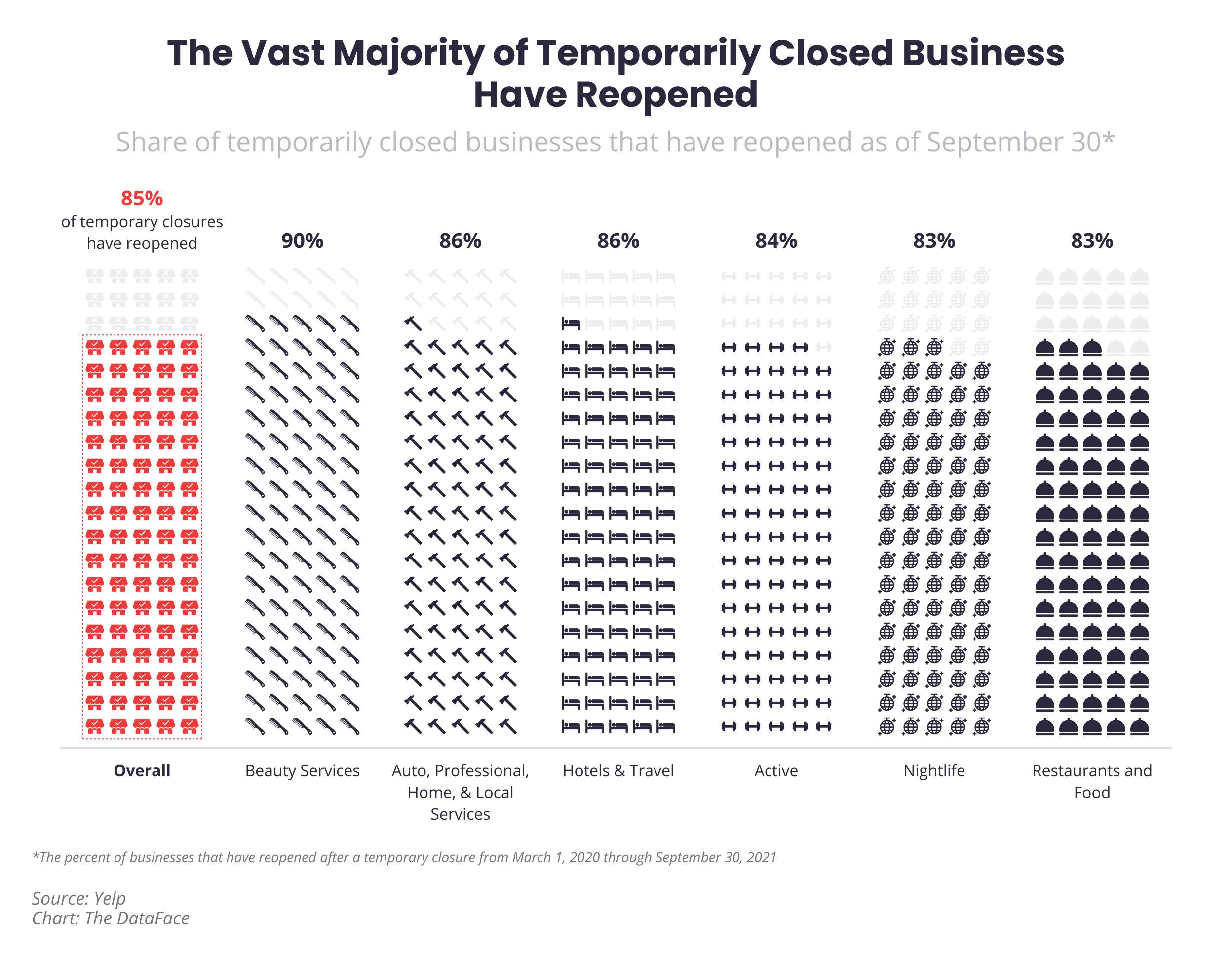
In its Q3 report, released in October, Yelp found that 85% of businesses in the US that went through a temporary closure during the pandemic have reopened.
To get this percentage, Yelp followed a few criteria:
- They counted U.S. businesses that were reported as temporarily closed and then reopened between March 1, 2020, and September 30, 2021.
- Temporary closures were reported by the business owner on the business’s Yelp page – including by changing its hours or through a COVID-19 banner.
- Each temporarily closed business was counted only once, on the date of its most recent closure.
- One-day closures that appear to be unrelated to the pandemic were excluded from the quota.
- The reopenings quota included the termination of temporary closures by a business through Yelp’s temporary closure feature, or by the editing of business hours (excluding holiday closures).
- Each reopened business was counted only once – on the date of its most recent reopening during the time period above.
#2. A/B testing content for different followers

Here’s a hypothetical example: you’re promoting an industry event on your LinkedIn page. Lots of people have signed up. This is a golden opportunity for you to serve them better with awesome follow-up content.
How do you do that with quota sampling?
- Consider running a series of polls that helps you get to know the people in your event. For example, ask them to choose an answer that describes their job role.
- Based on the job roles that pop up most often, you can craft relevant content that will be helpful for them.
- Then, you can use the quota sampling process to segment your audience into lists (based on their answers to the job role poll).
- Share the content and measure the opens, clicks, and response rates.
#3. Investigate the link between business ethics and consumer decisions
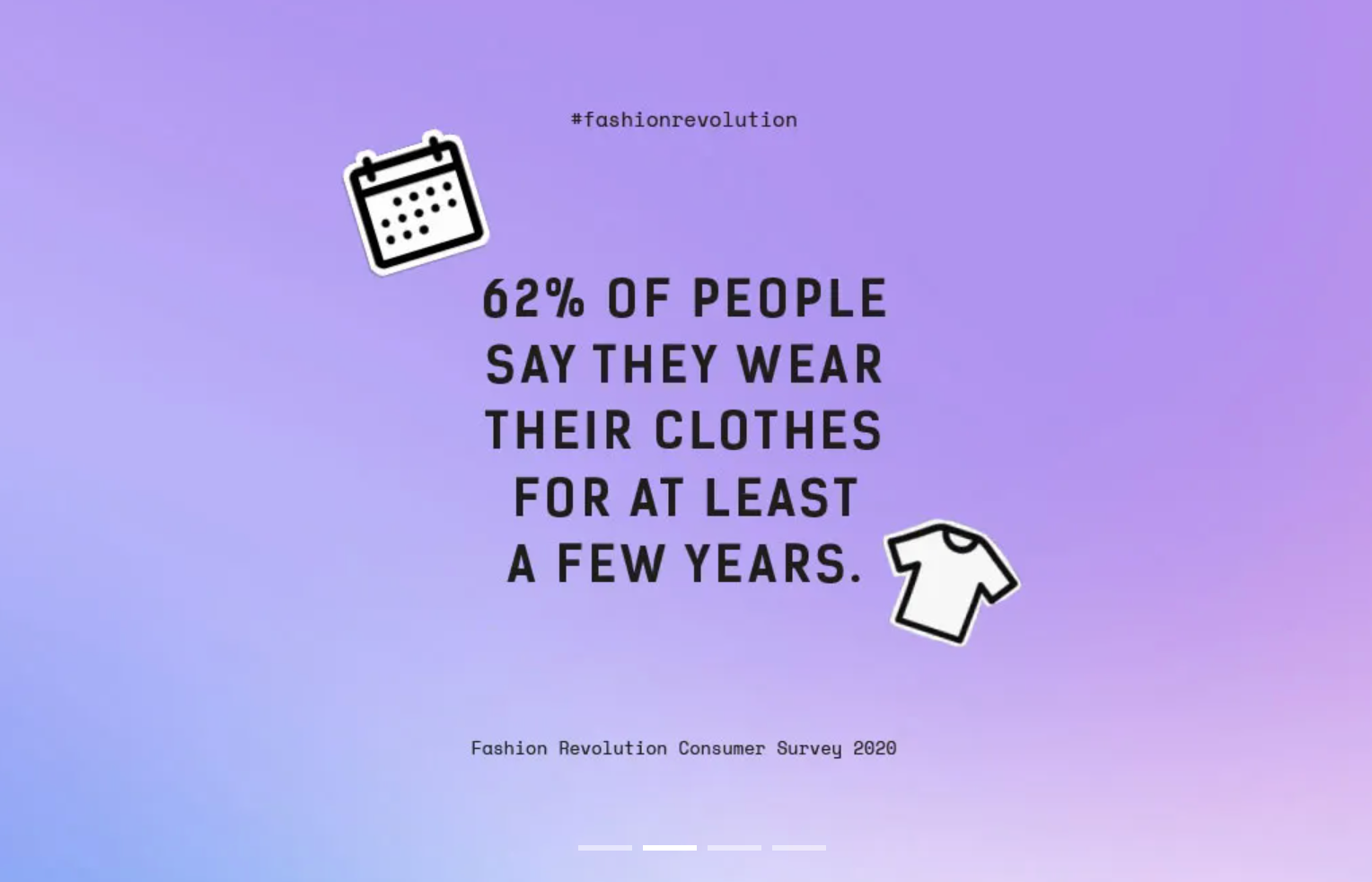
Fashion Revolution commissioned a notable survey in 2020 as part of a three-year project by the European Fair Trade Commission.
- The goal: find out how supply chain transparency, and sustainability, influences EU customers’ decisions when buying clothing, accessories and shoes.
- The study applied quotas on the age group of 16-75 within the EU’s biggest markets: the UK, France, Germany, Italy and Spain.
- Age, gender, region and work status were some of the weights used to create a final sample that represented the adult population of the UK.
Bonus example: Gathering employee needs from check in questions
Constant check-ins are vital for new hires and seasoned staff too! However, you may not have the time or resources to regularly share check-in questions with everyone at your company.
In this situation, the quota sample method can be a time-saver.
Wrapping up: Things to keep in mind while doing quota sampling
1. Quota sampling is not easy to generalize to the overall audience because it doesn’t account for deviation within segments.
For example, a global study on happiness measures how happy a nation is according to certain traits, and most nations fall along this mean.
However, some nations might have a very different cultural idea of what happiness is, so they fall further away from global happiness mean. Factors like this are hard to catch with quota sampling alone.
2. Choosing the final sample is ultimately up to the researcher’s judgment. Despite our best efforts, it is possible that bias will creep into the quota sampling process. When we keep these things in mind during the data collection and analysis, we can have greater confidence in the results.
And before you go, don’t forget to give SurveySparrow a try!