General
Quantitative Data Collection: A Quick Guide for Beginners

TRUSTED BY BEST-IN-CLASS BRANDS


What is quantitative data collection? It’s a research method that gathers and analyzes numerical data. Its purpose is to answer research questions, or test hypotheses. Pretty cool, right?
Moreover, the quantitative data structure allows statistical analysis and objective conclusions. That’s why it’s so popular among researchers.
In this guide, we’re going to explore:
- Data collection methods in quantitative research
- Data collection tools in quantitative research
- 7 best practices for quantitative data collection
- 7 common mistakes to dodge
- The role of quantitative data in decision making
6 Tried-and-True Quantitative Data Collection Methods
Surveys and forms
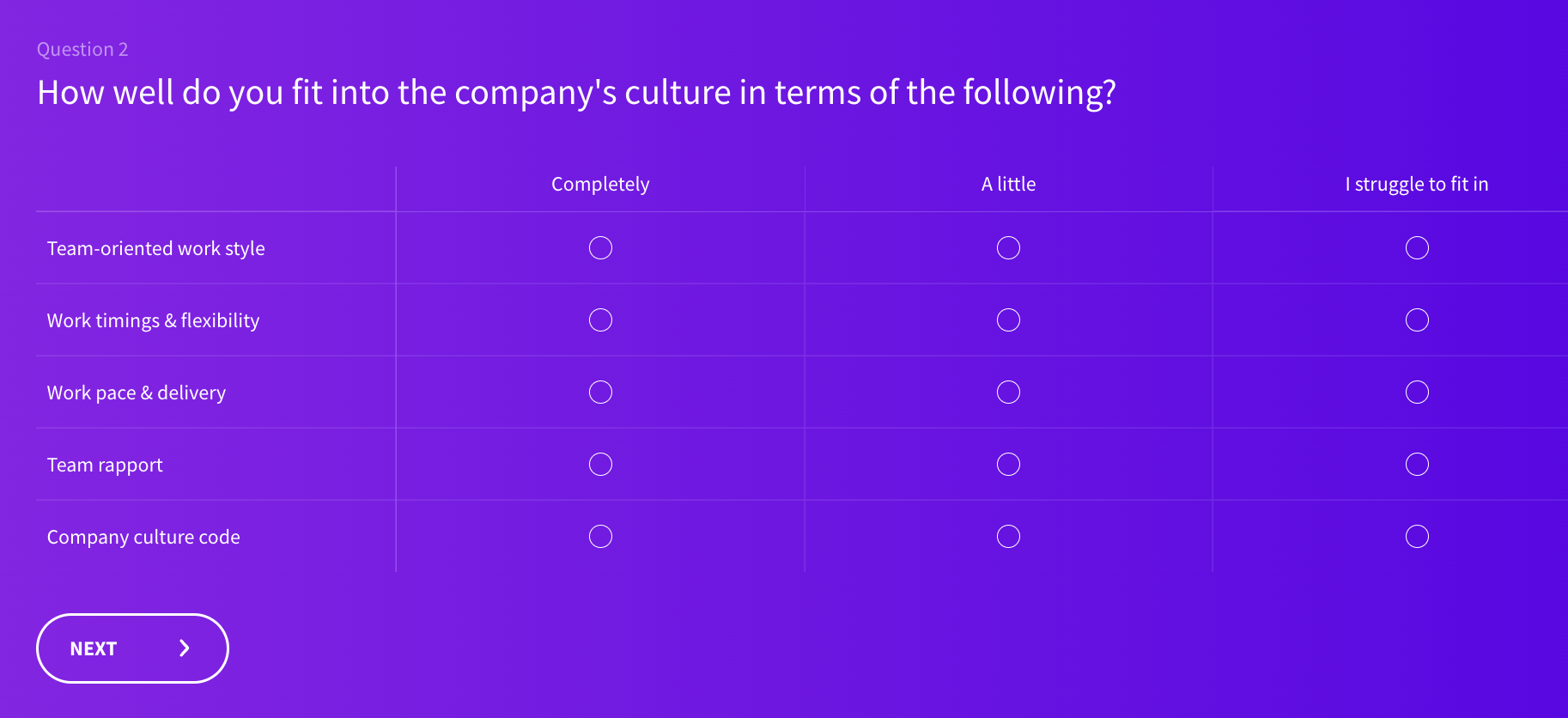
Surveys and forms are a common method of collecting quantitative data. They involve asking a large group of people to respond to a set of questions, either in person or online.
Forms are like surveys, but they are usually shorter, and more targeted to a specific group.
The process of conducting a survey involves:
- Designing a set of questions
- Selecting a sample of respondents
- Administering the survey
- Analyzing the results
You can survey people in various ways, including face-to-face, over the phone, by mail, or online. However, online surveys are one of the most popular methods, because they are cost-effective, easy to create and distribute
Need to collect quantitative data for your survey? Start getting insights with 3 active survey projects and custom report filters for FREE. Sign up with SurveySparrow.
Pros of surveys and forms:
- Their ability to collect data from a large sample of people.
- Flexibility in design, customization and distribution.
- Potential for anonymity, which can encourage respondents to answer truthfully.
Cons:
- The possibility of low response rates.
- Potential bias in the sample selection.
- The risk of respondents providing inaccurate or incomplete answers.
Interviews
Interviews involve asking a set of questions to individuals, or groups of people. to collect quantitative data. They can be conducted in person, over the phone, or online.
The process of conducting an interview involves:
- Preparing a set of questions.
- Selecting a sample of participants.
- Conducting the interview.
- Analyzing the results.
Interviews can be structured, semi-structured, or unstructured. It depends on the research question and the level of flexibility needed in the responses.
Pros of interviews:
- Their ability to collect detailed and nuanced data.
- Their potential for follow-up questions and clarifications.
- Ability to build rapport and establish trust with the respondents.
Cons:
- The potential for interviewer bias.
- Potential for the respondents to provide socially desirable answers.
- The time and resources required to conduct interviews.
Observations
Observations involve observing and recording the behavior of people or objects – in a natural or controlled setting – to collect quantitative data.
This data collection method can be conducted in various ways – including structured or unstructured observations, participant or non-participant observations, and covert or overt observations.
The process of conducting observations involves:
- Selecting a setting or situation.
- Determining the behaviors or events to be observed.
- Recording the data.
- Analyzing the results.
Observations can be conducted in real-time or recorded for later analysis.
Pros of observations include:
- Their ability to capture behavior in a natural setting.
- Potential for rich and detailed data.
- Their ability to reveal patterns and trends that may not be evident through other methods.
Cons include:
- The potential for observer bias.
- Potential for participant behavior to be affected by the presence of the observer
- The time and resources required to conduct observations.

Polls
Polls involve asking a specific question, or set of questions, to a large group of people to collect quantitative data. Additionally, polls can be conducted in various ways, including over the phone, online, or in person.
The process of conducting a poll involves:
- Preparing a question or set of questions.
- Selecting a sample of respondents.
- Administering the poll.
- Analyzing the results.
Polls can be conducted on a one-time or ongoing basis, depending on the research question and the level of data needed.
Pros of polls include:
- Ability to collect data quickly and efficiently
- Their potential for a large sample size
- Ability to track changes in public opinion over time.
Cons include:
- The potential for bias in the sample selection.
- Possibility for leading or ambiguous questions.
- The potential for respondents to provide socially desirable answers.
Experiments
Experiments involve manipulating one or more variables in a controlled setting to collect quantitative data.
In addition, experiments can be conducted in various ways, including laboratory experiments, field experiments, and quasi-experiments.
The process of conducting an experiment involves:
- Selecting the variables to be manipulated.
- Selecting a sample of participants.
- Administering the treatment.
- Analyzing the results.
Experiments require a high level of control and standardization to ensure accurate results.
Pros of experiments include:
- Their ability to establish cause-and-effect relationships between variables.
- Potential for high internal validity.
- Their ability to replicate and generalize findings.
Cons include:
- The potential for low external validity.
- Possibility of ethical concerns.
- The time and resources required to conduct experiments.
Document/ Archival Reviews
Document reviews involve analyzing existing documents to collect quantitative data. Documents can include official records, reports, publications, or any other written material that is relevant to the research questions.
The process of conducting a document review involves:
- Selecting the documents to be analyzed.
- Developing a coding scheme.
- Collecting and analyzing the data.
- Drawing conclusions based on the findings.
Pros of document reviews include:
- Their ability to collect data from a wide range of sources.
- Potential for high reliability and objectivity.
- Their ability to access historical or hard-to-reach data.
Cons include:
- The possibility of incomplete or inaccurate data.
- Potential for researcher bias in the selection and analysis of documents.
- The time and resources required to conduct a thorough review.
Data Collection Tools in Quantitative Research
Data collection tools are basically instruments that are used to collect data in a standardized and consistent way. So different methods of quantitative data collection need different data collection tools.
- For surveys, data collection tools can include paper questionnaires, online surveys, offline kiosks or phone surveys.
- For interviews, data collection tools can include interview guides or scripts.
- During observations, tools of data collection can include observation checklists or rating scales.
- For polls, data collection tools can include questionnaires or online polling apps.
- For experiments, data collection tools can include treatment protocols or observation protocols.
- In document reviews, data collection tools can include coding schemes or data extraction forms.
7 best practices for collecting quantitative data
If you want to make sure that the data you get is accurate and reliable, there are some best practices you should follow in quantitative data collection.
Here are a few of them:
- First things first, make sure you clearly define your research question and objectives. You need to know what you’re trying to achieve before you start collecting data.
- Next, select an appropriate data collection method and tool that will help you answer your research question.
- It’s also important to develop a sampling plan and select a representative sample. This will help ensure that the data you collect is relevant to your research question.
- Before you start collecting data, it’s a good idea to pilot test your data collection tool to make sure it’s effective.
- Train your data collectors to ensure that everyone is on the same page and knows what to do.
- Monitor the data collection process to ensure quality control. This will help you catch any issues before they become major problems.
- Finally, use appropriate statistical techniques to analyze the data. This will help you make sense of the data you’ve collected and draw accurate conclusions.

7 common mistakes to avoid in quantitative data collection
Gathering quantitative data is no easy feat – it requires careful planning, execution, and analysis.
But even with the best of intentions, researchers can make mistakes that lead to inaccurate or biased data. Here are some of the most common pitfalls to avoid:
Using biased or unrepresentative samples:
It’s important to ensure that the sample you collect is representative of the population you’re interested in. Otherwise you will get results that don’t accurately reflect the population’s characteristics.
To avoid this, researchers should use random sampling techniques that give everyone an equal chance of selection.
Using poorly designed data collection tools
The data collection tool is a key part of quantitative data collection. Messily designed tools can result in incomplete or inaccurate data.
To avoid this, researchers should take the time to design their data collection tools, test them with a small sample of participants, and revise them as needed. You can also take advantage of survey templates online as a lot of thought has already gone into crafting them.
Failing to establish clear research questions and objectives
Having a clear focus is essential for successful data collection. Without a clear research question and objectives, your data collection efforts can become scattered and unfocused, leading to data that’s difficult to interpret and use.
Make sure to establish clear research questions and objectives before you start collecting data.
Failing to pilot test the data collection tool
Testing (or “piloting”) your tool is key to ensuring its effectiveness.
Piloting involves testing the tool with a small sample of participants. Piloting can help researchers identify any issues with its design or implementation, and fix them before they spread.
Skipping the training of data collectors
To ensure consistency and accuracy in data collection, researchers must train their data collectors on the tool and the research objectives.
Data collectors need to understand the protocol and its reasoning. Without adequate training, data collectors may miss important data or record it incorrectly, compromising the data’s validity.
Failing to monitor the data collection process
Researchers need to oversee the data collection process to ensure that:
- The data collectors follow the protocol correctly.
- Data is collected on time.
- The data is recorded accurately.
Without monitoring, data collection efforts can become unfocused and ineffective.
Using inappropriate statistical techniques to analyze the data
The statistical analysis of quantitative data is a vital step in the research process. Using inappropriate statistical techniques can lead to misleading or incorrect conclusions.
Because of this, a lot of researchers use online survey tools, like SurveySparrow or Qualtrics, which have an automatic report generation feature. This cuts short the time spent on statistical techniques and reduces the chance of human error.
In short, dodging these mistakes ensures the accuracy and reliability of your quantitative data collection. By doing so, you’ll be able to gather valuable insights, and make evidence-based decisions.

The role of quantitative data collection in decision making
- Quantitative data collection plays a vital role in decision making in various fields – including business, healthcare, education, and public policy.
- Quantitative data can provide insights into key areas like – consumer behavior, product performance, patient outcomes, student achievement, and social trends.
- By collecting and analyzing quantitative data, decision makers can make informed decisions based on objective evidence rather than intuition or assumptions.
- Quantitative data can help identify patterns, trends, and relationships between variables, which can inform strategies and interventions.
For example:
- In healthcare, quantitative data can help identify risk factors for diseases, evaluate the effectiveness of treatments, and track patient outcomes.
- In business, quantitative data can help identify market trends, assess the performance of products or services, and inform pricing strategies.
- In education, quantitative data can help evaluate the effectiveness of teaching methods, assess student learning outcomes, and inform curriculum development.
Wrapping Up
In conclusion, quantitative data collection is a great example of a deductive research approach. This makes it an essential tool for researchers and decision makers in various fields.
By following best practices and avoiding common mistakes, researchers can collect accurate, reliable and actionable data. Moreover, the right tools can reduce the chances of human error. Get in touch with our team to find out how we can help with your next survey project.