Best Of
Employee Performance Review: Checklist, Tips & Template for Managers

Article written by Kate Williams
Product Marketing Manager at SurveySparrow

12 min read
11 June 2024


Best Of
Article written by Kate Williams
Product Marketing Manager at SurveySparrow
12 min read
11 June 2024
Every team needs an employee performance review. But its value varies according to the way you handle it.
Regardless of the type of review, you need to go beyond ticking boxes if you want to make it a meaningful exercise. So, here’s the ultimate guide to help you design and navigate employee performance reviews – in-person or virtually.
A performance review is a formal assessment of employees by an HR team or a manager. This review is meant for identifying the strengths and abilities of an employee, and judging their overall work performance.
A performance review will include data on the employees’ work performance, productivity, and skillset. We use this data to help employers offer feedback, set goals, and benchmark progress for employees’ work performance.
Reviews can be yearly, quarterly or even monthly performance check-ins. For example, Adobe replaced conventional reviews with regular check-ins instead of annual check-ins for their employees. Other companies like GE and Deloitte are ditching their legacy performance management systems to focus on one-on-one reviews.
Before the pandemic, an employee performance review was once-in-a-while event. But after the Great Churn, more companies are realizing the importance of mental health in employee performance.
That’s why leading companies like Facebook, Sprinklr, and SNI are increasing regular check-ins. In this post-pandemic era, employers can follow these three principles for conducting performance reviews in a more empathetic way.
89% of HR leaders say that ongoing peer feedback and check-ins are critical for successful outcomes.
Doing a performance review without goals or standards is like trying to pour water without a glass. A clear performance standard defines what you’re looking for in an employee.
For example, you are the lead of a sales team, Your quarterly goal is to bring in $60,000 in sales per quarter per salesperson. When you do a quarterly performance review, this is the standard that you will apply.
Performance standards are tailored to an employee’s specific role, and apply to all employees with the same job role.
Once you set the goals and standards for each employee, arrange a meeting, and share them with your entire team. This will help your employees know what you expect from them when it’s time for the employee appraisal.
Always ensure that you support your feedback with examples or observations. This is best done by tracking your employees’ performance throughout their journey with the help of an employee assessment file or performance log.
Let’s say you notice that one of your employees was absent for two days without informing anyone. Or maybe someone worked overtime and on the weekends to complete a project. You can record these events on your assessment file and use this information during the employee performance review.
Heads up: If someone does an exceptionally great job, don’t wait for a year to tell them so! Give immediate feedback – this is a huge morale booster and boosts employee engagement with their jobs.
Organizations with highly engaged employees are 21% more profitable than others.
360 degree feedback sources employee performance reviews from managers, colleagues, and even customers. In short, it gives a holistic picture of their work performance as employees, team members and brand ambassadors.
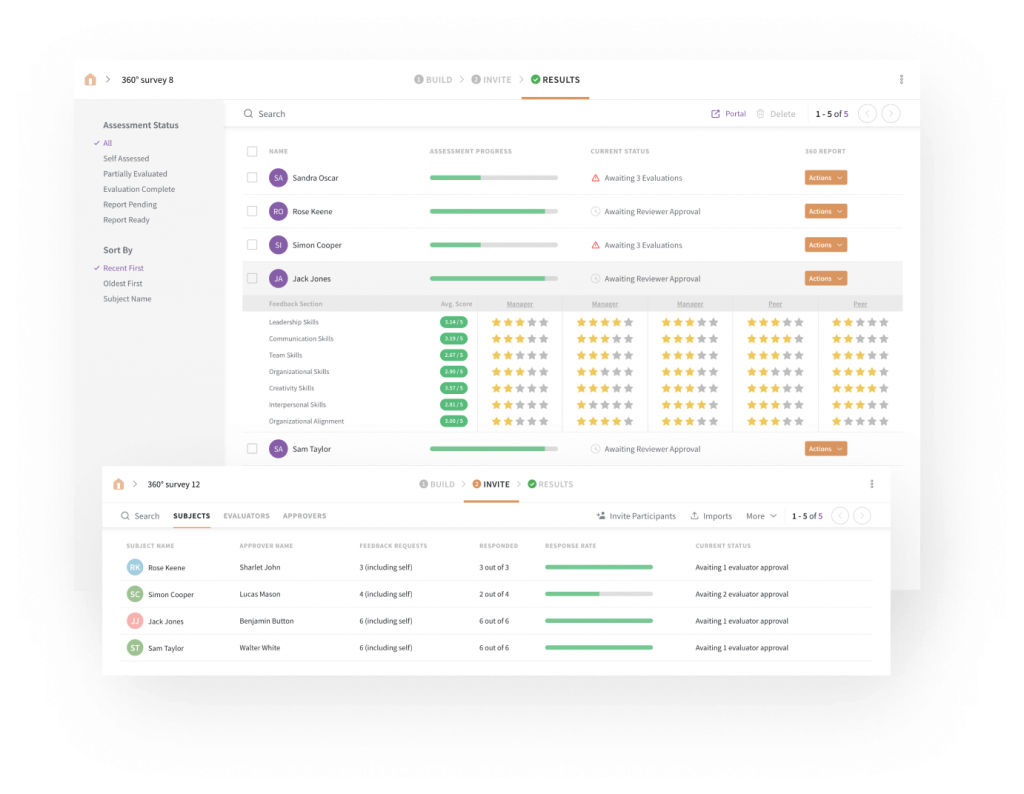
360-degree feedback software, like SurveySparrow, automate employee performance reviews so that you can focus on actually drawing out insights that will help the employees.

With various filters – like Self-Assessed, Partially evaluated, Report Ready, Evaluation Complete, and Report Pending, you can track employee assessments easily. Finally, you can share the review reports with the employees – completely personalized with your brand kit. Wonderful, isn’t it? You can try all of them out with a free trial.
As per Reboot, a brand’s signature color can increase brand recognition by 80%.
Imagine you had to wait a whole year to share your concerns with the management. Frustrating, isn’t it? That’s why regular, real-time performance reviews are important – even a two-minute conversation will do. Your employees want to feel the company cares about them, and they want to know how they’re doing.
Performance review surveys include questions like things they’re proud of at work, their strengths and weaknesses, etc. Evaluating the answers will tell you exactly where your employees, programs or policies need improvement.
According to Emplify, by collecting employee feedback, boat manufacturer T-H Marine increased its production capacity by $3.8 million.
Face-to-face meetings can be exhausting. But these sessions are helpful to create a relationship on a personal level, and build trust between your employees and managers.
The first step to creating a face-to-face meeting is determining the evaluation’s purpose. Feedback doesn’t have to be all negative. It could be about an employee’s performance on a particular project, or a team’s performance on difficult tasks, etc.
Also, your employees need enough time to prepare themselves before attending the performance review meeting. So, mention the purpose and schedule of the meeting beforehand.
Employee NPS (eNPS) lets you know how many of your employees would recommend your company to others. The NPS is represented as a rating scale between 0 to 10. On a scale of 0-10, your respondents will give ratings on performance.
For example, you can ask your customers to rate a certain service provided by your company. If your customers feel satisfied with the service, you can reward your employees for providing excellent service. You can also use eNPS to discover your most passionate employees.

Once you get a clear idea about your employees’ performance from the surveys and feedback, it’s time to act on the reviews. If a section of employees need improvement in a certain area, schedule training programs. This will allow them to improve their weak spots.
Make sure to align your management goals with the training and development programs. If your management goals are to improve productivity, customer satisfaction, and employee productivity, then design training programs and conduct performance reviews accordingly.
If one of your employees has achieved a milestone, or completed a project, make sure to celebrate their wins. Rewards and recognition will boost your employees’ mood and productivity. Even simple rewards like a gift voucher, a team night out, or dinner or movie nights will make them feel valued and cared for.
You can use this Employee Incentive Questionnaire to understand what benefits or rewards they like to receive. This way, you can create a rewards policy that employees will love.
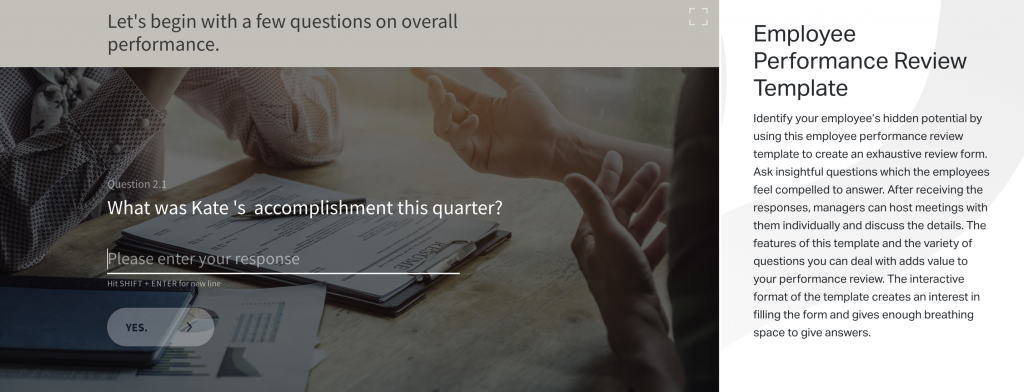
Here’s a free Employee Performance Review form to get you started. You can customize this with your own brand kit, questions and design to make it your own.
Related: How to write performance review comments.
With our performance review checklist, you’ll be on the road to creating an engaged workforce. This checklist not only helps you to enhance employee skills but also ensures company growth for the long-term.
However, remember that performance reviews aren’t a one-way road, where the employers talk and employees listen to the feedback. In today’s world, it’s all about conversations. So, listen to your employees well, and provide them great performance reviews that will help them grow personally and professionally.


Thousands of brands trust SurveySparrow to turn feedback into growth. Try it free today!


Best Of
8 MINUTES
24 November 2023

Best Of
15 MINUTES
4 October 2018

Best Of
7 MINUTES
19 September 2022

Best Of
14 MINUTES
9 April 2021
14-day free trial • Cancel Anytime • No Credit Card Required • No Strings Attached

