Best Of
What Is Net Promoter Score Facts & 12 Factors That Will Blow Your Mind!

Article written by Kate Williams
Product Marketing Manager at SurveySparrow

20 min read
6 June 2024


Best Of
Article written by Kate Williams
Product Marketing Manager at SurveySparrow
20 min read
6 June 2024
If you’re a manager or business owner, it’s just impossible to sleep some nights, won’t you agree?
The reason for these sleepless nights could be many things, out of which what your customers think of your product or brand and whether they like your business enough to recommend others are the two most common ones.
Well, the answer to both lies in one word: loyalty! Every business owner’s biggest dream is to grow their business and make customers happy. And one simple way to make this dream come true is by measuring customer net promoter scores. The NPS allows you to measure customer loyalty to give them the best possible experience throughout a customer’s journey.
Now, this metric to gauge customer experience has some mind-blowing facts! Here’s our compilation of 12 interesting facts on the NPS score to help you understand this metric a little more. So, read on to discover these incredible facts and get ready to collect the voice of your customer!
Technically speaking, the net promoter score is a popular metric used for measuring customer loyalty. You can calculate your customer NPS score with a simple question like this;
“How likely are you to recommend our product/service to a friend?”
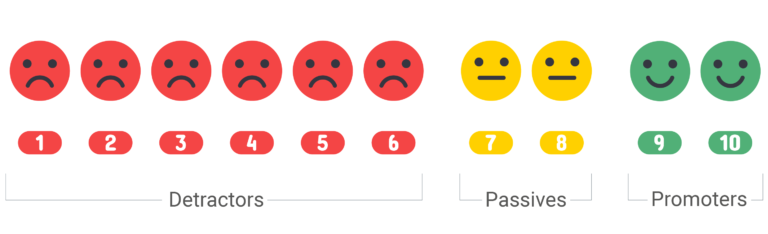
In the NPS survey, respondents are asked to give a rating between 0 and 10. Based on their responses, you can categorize them into three segments;
Net Promoter Score (NPS) is a key metric for gauging customer loyalty and satisfaction. Here’s why NPS is important:
In essence, NPS is a powerful tool for businesses to understand their customer loyalty landscape and make informed strategic decisions.
Calculating NPS is simple. All you need to do is subtract the promoter percentage from the percentage of detractors. %Promoters – %Detractors = NPS
Simple, right? Now, let’s get to the real deal! Read on.
Presenting some facts about CNPS that can help improve your CX in the long run.
No one wants to stay connected with a brand that treats its customers poorly. A brand’s survival depends solely on customer trust and loyalty, especially when the world is still dealing with the COVID outbreak. So, companies must gauge their customer loyalty, attitude, and sentiment. That’s why several organizations have been using CSAT(Customer Satisfaction), CLV (Customer Lifetime Value), and CES (Customer Effort Score) worldwide.
Among all these customer experience KPIs and metrics, the customer net promoter score is the most popular. Why? You don’t have to be a statistician to use or administer an NPS score. The entire concept of NPS is based on a straightforward question that we discussed before;
“How likely are you to recommend this brand/product/service to a friend?”
You can always send follow-up questions after this to understand why customers would recommend your business or not.
Calculating the NPS score is no rocket science (we mentioned the formula earlier). To understand your customers’ attitudes towards your brand, you only need to ask and share a simple question through different channels, like email or social media. That’s it. With only this much effort, you’ll get to know the customer’s sentiments towards your brand. Pretty cool, what say?
To improve customer experience using SurveySparrow, feel free to sign up for FREE now!
When Bain and Company first developed a net promoter score in 2003, it was meant to measure customer loyalty. That’s why most NPS surveys are designed to gather customer feedback only. But the fact is, you can use the net promoter score to gauge your employee sentiment, too.
ENPS a.ka. Employee Net Promoter Score measures your employees’ loyalty. With this, you find how likely your employees are to recommend your work to others. In fact, because of the lack of complexity, the net promoter score is better than any other employee engagement survey. Managers don’t have to waste hours to develop the right survey question. Employees can avoid survey fatigue by answering only one question (“How likely are you to recommend our workplace to your friends and family?”). In short, ENPS is one of the easiest metrics to work with.
However, NPS alone can’t give you an entire picture of the employee experience. You can use it with surveys like yes/no, Likert scale, matrix type, and open-ended to collect valuable data. (Or, you can use SurveySparrow’s survey templates to make your surveys look the best they can!).
The customer net promoter score allows you to measure your customers’ loyalty, and your managers can use it for workplace management. They can compare different departments in your organization to see if they provide excellent services. For instance, using the NPS system, you can measure if the development team in your company receives a better score than the field service department. If not, you can focus on improving the development team so that every department in your organization gets equal scores.
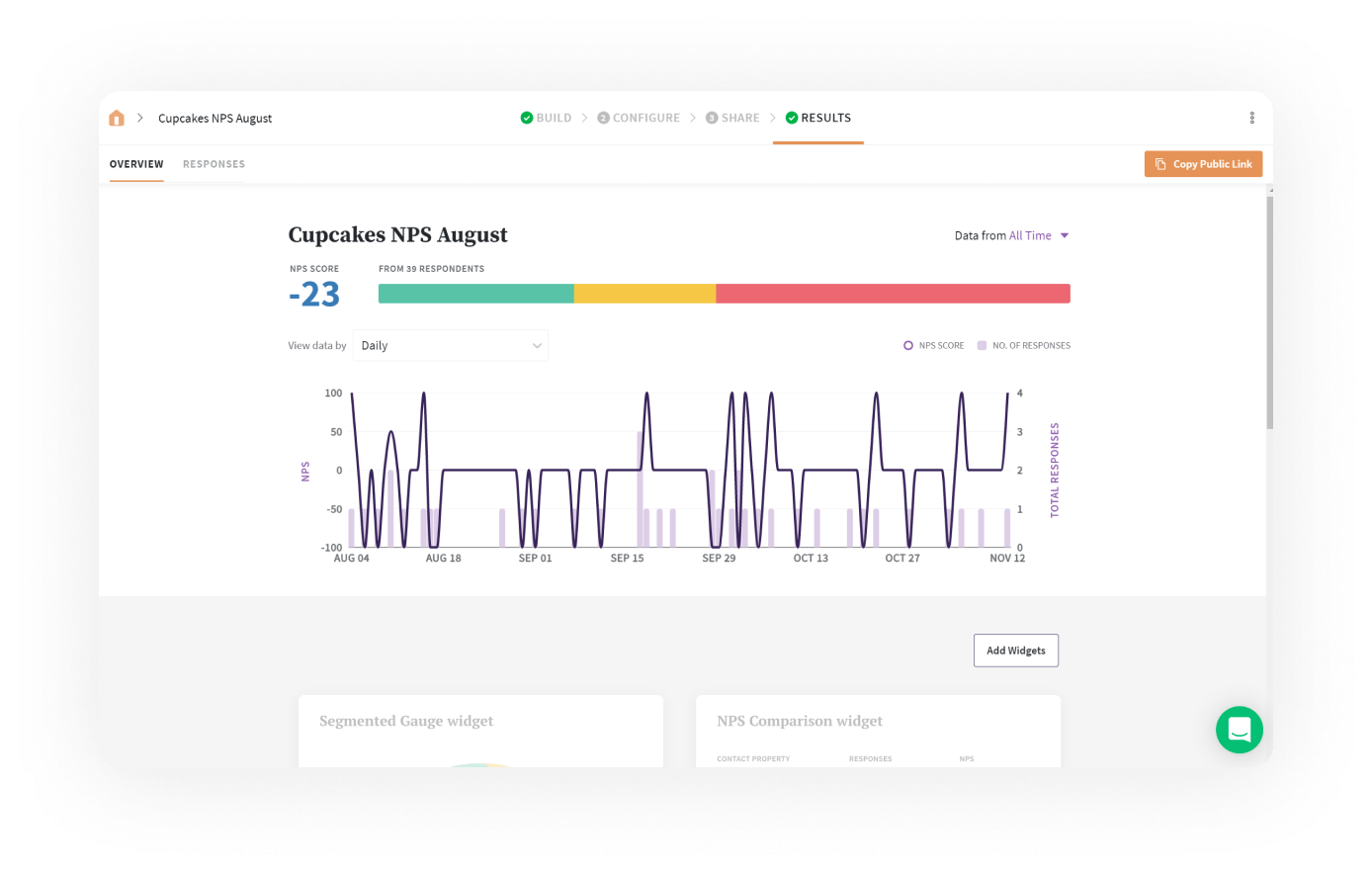
Customer net promoter score can range from -100 to +100. And good and bad scores mainly depend on different industries. Generally, an NPS score below 0 would be considered an unsettling score for businesses. A score between 0-30 can be determined as neutral. If your NPS score is 30+, customers are more than happy to stay connected with you. Finally, if your NPS score is higher than 60, then your customers will certainly spread a lot of positive reviews!
However, your absolute NPS score isn’t as crucial as your relative NPS ranking. Your brand’s position relative to your competitors is what makes the impact. Therefore, it’s vital to benchmark your NPS number with your industry average to understand your customer net promoter score better. For example, let’s imagine two different organizations in two various industries. Organization 1 has an NPS score of 50, the top NPS within its industry. While Organization 2 has an NPS score of 70, it’s the third-best company within its industry. Although Organization 1 has a lower NPS score, its top position in the industry will provide it with benefits that Organization 2 won’t experience.
Take Microsoft, for example. As per pcmag, the NPS score of Microsoft is 69. On the contrary, Tesla’s NPS score is 97. Does that make Tesla better than Microsoft? Not likely; both of these companies belong to different industries, and their NPS score is based on their industry benchmark. The fact is Tesla (automobile industry) and Microsoft (software industry) both have an excellent NPS score in their respective industry.
NPS scores are nothing without follow-ups! Net promoter score only tells you how likely someone is to recommend your brand. But it doesn’t tell you what to do with the negative scores. This is where NPS follow-ups come into play.
Following up, your detractors and passive respondents can work like a wonder to determine the root cause behind their score. Follow-ups will help you understand exactly what aspects of your product or service are valuable for the audience. Also, it will allow you to know why your customers rate your product negatively. Based on their answers, you can quickly improve your business strategy and product for the future.
Here are a few NPS follow-up questions you can ask your customer to analyze their scores:
Here’s a heads up: while following up with your customers, send them a customized thank you mail to increase the customer experience. “Thank you” emails are a great way to show appreciation and gratitude towards the customer. Below, we’ve listed some NPS email examples that you can use at the end of your email.
For Promoters: “Thank you for the response! It’s always great to hear from a fan. As a thank you, we’re giving you one month of free access to our product!”
For Detractors: “Thank you for your feedback. We appreciate your opinion. In the future, our team will work towards providing a better experience.”
Benchmarking your company against competitors using CES or CSAT metrics is almost impossible. The reasons behind these are: a) CES measures how much effort your customers make to meet their expectations. But it doesn’t help you benchmark data or compare your organization with competitors. b) Establishing industry benchmarks with the CSAT metric is nearly impossible as it can only measure the last interaction your customers have with your business, product, or services.
The customer net promoter score makes it extremely easy for you to benchmark your company against competitors. With NPS benchmarks, you can measure and compare organizational progress. And when you’re gunning for impressive growth, such comparisons become crucial.
Recent timing and global events are crucial factors that may influence customer net promoter scores. Why? Well, people’s expectations and needs change based on certain international or local events. However, the chances of having a significant global event are rare but not impossible.
For example, the COVID pandemic has recently caused significant changes in NPS survey scores. Many businesses were affected massively because of the outbreak, and the customers weren’t in a great position either.
To measure the influence of global events, recently Qualtrics researched 10,000 US consumers in 20 different industries (May 2020). The research shows us:
Also, at the initial stages of the pandemic, several organizations couldn’t cope with the new reality, which caused bugs, errors, slow processing, and eventually low NPS customer satisfaction. So, your NPS scores can change with global events and changes.
You can’t solely depend on the customer net promoter score. The NPS is an excellent metric to tell how likely a customer is to recommend your product to others. However, it doesn’t mean whether they will purchase from you again. Also, sometimes people say one thing and do something else. According to Forbes, there are three types of customer loyalty: purchasing, advocacy, and retention. Now, NPS helps you measure advocacy loyalty, but what about the others?
In our experience, mix and match your survey metrics if you want to go beyond loyalty and measure the overall customer experience. That means you can and should use all three metrics- NPS, CSAT, and CES to gather valuable customer feedback throughout your customer journey.
The net promoter score can change over time. Global changes are one reason, but the other crucial one is- competition. You see, competition is everywhere. And you can’t succeed just by providing a working product. In today’s world, customer expectations are high and change rapidly. So, it’s difficult for companies to deliver a product that’ll keep the customer experience high throughout their journey.
That’s why, to stay relevant, you have to track your customers frequently and uncover changes. So, as a suggestion, we recommend you measure NPS at least twice a year.
Besides measuring your customers’ sentiment, regular surveys are crucial for tracking your business performance throughout the year. For example, Atlanta, Georgia-based company Vector increased its survey response rate, gathered insightful data to understand customers’ preferences, and improved its overall customer experience by conducting regular surveys annually using Surveysparrow’s survey software.
“SurveySparrow is helping us obtain insight into our leads’ and customers’ perceptions of our products and our company – which is very important to us. We always want to be evolving.”- Vector Networks.
See how we’re helping them? Well, we can do something similar for you, too. You’ve just got to talk to us.
Famous customer metrics like CSAT and CES are meant to gather short-term customer data, as you can only send these surveys after a customer purchases a product or gets service from you. These metrics measure a customer’s last interaction with your business. For example, let’s assume the customers love the Saas products your company offers. But, they had a terrible experience with your customer support team. You’ll get poor results if you conduct a CSAT or CES survey based on the interaction with the support team.
However, the NPS score looks at the bigger picture. It allows you to measure customer sentiment based on your product, service, social image, brand credibility, etc. By sending NPS surveys, you can identify happy customers and your advocates. These satisfied customers will support your company through thick and thin. You can use them for testimonials, product feedback, case studies, interviews, referrals, and more.
On the other hand, customers with low NPS scores are at the risk of leaving. These customers aren’t loyal, but following up with them regularly can open endless possibilities for your business. Proactive attention to these customers can improve your overall business health, and you can stay apart from the competitors.
Do you know that your customers’ tolerance level can influence NPS scores? But wait! What is a tolerance level? Well, today’s customers have higher expectations of your product. They care how much value your product can deliver regularly. Their tolerance level depends on how much the service or product can impact their lives.
You can learn about the customers’ tolerance level by asking, “On a scale of 1-10, how likely are you to get angry if we can’t meet your daily expectations?” If the respondents answer with a perfect ten or closer to that, your business operates in a low-tolerance industry. However, if the respondents principally answer with lower numbers like 2-5, your company operates in a high-tolerance sector.
If your business is in a low-tolerance industry, you can increase tolerance by providing a better customer experience, transparency, and accountability. For example, Netflix and Uber managed to gain high tolerance despite being a part of the low-tolerance industry.
If you want to maximize your NPS score, sending surveys manually from a regular mailbox is a terrible idea. And calculating the results in a spreadsheet is even worse! Using a standard mailbox or spreadsheet can undoubtedly give you some scores, but the real benefit lies in using specialized survey software. Modern-day survey software is made with customer net promoter score in mind. Also, they have superb analytical features that collect rich data. So, if you don’t want to narrow down all the benefits while conducting a survey, NPS survey software is an excellent investment for your organization. Speaking of specialized software, we’ll discuss what to look for in NPS software in our next point.
Running NPS (Net Promoter Score) surveys effectively is crucial for businesses keen on understanding customer loyalty. Here’s a step-by-step guide on how SurveySparrow can assist:
If you’re considering investing in NPS software, choose the one that offers personalization. The right software will allow you to personalize the brand’s logo, color, font style, and even survey URL to personalize every bit of your NPS survey. This will help you to build a sense of brand authority and identity for your customers. As per a Salesforce study, 57% of shoppers stated they’d share their information if they received personalized offers.
Also, once you start sending NPS surveys based on customer segments, triggers, and customer journeys, you must ensure the NPS questionnaire is personalized for each customer. With an ideal survey tool, you can personalize your NPS email to address each customer based on their net promoter score.
Another great feature to look for in NPS software is the ability to schedule. Scheduling surveys allows you to send surveys based on customer preferences, availability, and time zones. The systematic survey is a feature that lets you set up and automate surveys at any time or frequency. SurveySparrow’s software allows you to set up separate reminder emails for non-responders to ensure high survey completion rates. Also, by setting automatic notifications, you can remind yourself to follow up with detractors and passives.
The main goal of an NPS survey is to measure your customer likelihood score after gathering feedback. So, invest in software that stores all the customer net promoter scores in real time. If you want to segment your customer based on their location or other criteria, look for NPS software that lets you filter the data. For instance, with SurveySparrow, you can filter the survey responses based on questions, answers, respondent details, and more advanced report filters. With cross-tabulation, you can even compare responses, trends, and patterns to understand your customers better.
Before wrapping up, here are a few questions you can ask yourself to make a more informed choice:
In summary, we can say that the customer net promoter score is the best loyalty metric a business can use. Once you learn how to define a good NPS score and follow up with the respondents effectively, you’ll be able to improve your brand image, product, and overall customer loyalty. Moreover, knowing these NPS facts will help you understand how different factors influence the score and collect valuable data effectively. And the more data you’ll collect and analyze with the NPS software, the more you’ll learn about the valuable customers.
So, what’s the wait? Get started with the NPS score today to wow your audience with an excellent customer experience. And, before leaving, don’t forget to let us know which of these 12 facts surprised you the most.
Till then, keep surveying!


Thousands of brands trust SurveySparrow to turn feedback into growth. Try it free today!


Best Of
15 MINUTES
13 October 2020

Best Of
15 MINUTES
10 December 2020

Best Of
18 MINUTES
17 February 2021

Best Of
18 MINUTES
21 May 2019
14-day free trial • Cancel Anytime • No Credit Card Required • No Strings Attached
14-day free trial • Cancel Anytime • No Credit Card Required • No Strings Attached
14-day free trial • Cancel Anytime • No Credit Card Required • No Strings Attached

