Compare
CSAT vs NPS: Understanding the Variances in Feedback Measurement

Article written by Kate Williams
Content Marketer at SurveySparrow

14 min read
17 April 2024


Compare
Article written by Kate Williams
Content Marketer at SurveySparrow
14 min read
17 April 2024
Did you know that 91% of unhappy customers leave without a word? And according to Forbes, a harsh 96% will abandon you for lousy customer service! This stat shows us the importance of measuring customer experience. But which metrics should we focus on? When it comes to feedback metrics, CSAT vs NPS has been a long-running battle.
In this blog, we will look into the different aspects of CSAT and NPS in terms of meaning, elements, measurement, assessment, and all you need to know about the two.
But hey, if you’re here for a quick comparison, I have added a table at the end.
So, shall we begin?
This is our happiness meter!
It’s a way to determine how much they liked or disliked their experience with your business. Imagine it as a thumbs-up or thumbs-down for the service you provided.
CSAT measures satisfaction by asking, “How satisfied are you with [product/service/interaction]?” Customers then give a rating, often on a scale of 1 to 5 or 1 to 10.
For instance, after a delightful shopping experience, a customer might give a high rating, indicating they are pleased. On the flip side, the rating would be lower if they faced issues or weren’t satisfied.
So, it helps you pinpoint what’s working and what needs improvement.
Here’s a free template made with SurveySparrow. Feel free to test it, customize it, and make it your own!
Customer Satisfaction Survey Template
Use This TemplateNow, let’s see…
Net Promoter Score is like a compass guiding you to customer loyalty and advocacy. It’s not just about satisfaction. It goes a step further. How? By exploring whether your customers would shout your praises from the rooftops!
Here’s the breakdown: NPS is measured by asking customers one crucial question, “How likely will it be for you to recommend our product/service to a friend or colleague?” They respond on a scale from 0 to 10.
Now, customers fall into three categories based on their responses: Promoters, Passives, and Detractors.
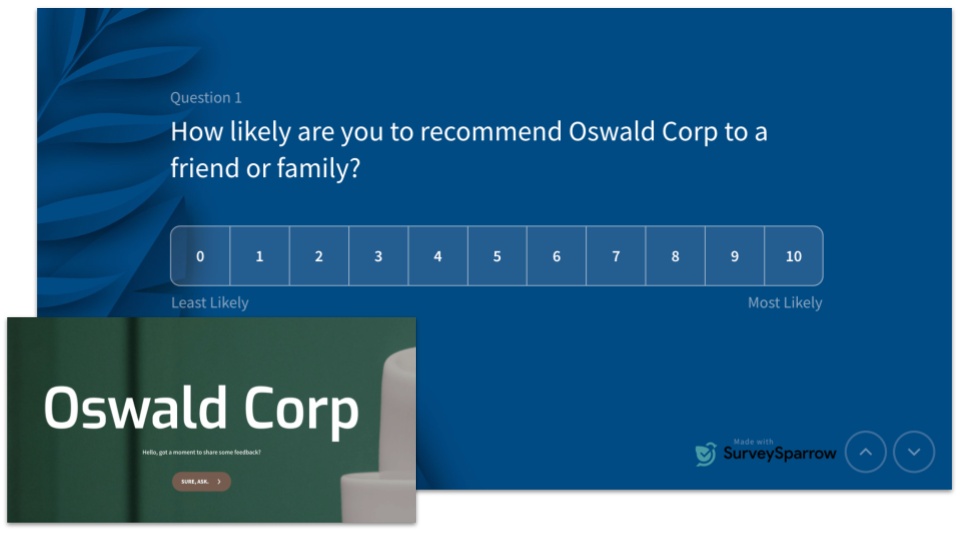
To calculate NPS, subtract the percentage of Detractors from the percentage of Promoters. The result gives you a snapshot of your overall customer advocacy. (We will look into all this in detail)
Now that we have a clear overview of the two feedback metrics, we will look into them in terms of…
I have divided the content into three sections for your convenience. We will look at the two metrics based on:
Let’s start with,
We know that customer satisfaction score is like a radar that helps you gauge how customers feel about specific interactions.
For instance, a customer bought your product and provided a rating after using it. If it’s a high score, great news! They’re satisfied. If it’s a lower score, there might be room for improvement.
Measuring customer satisfaction is a precision tool that offers a snapshot of customer satisfaction after a specific interaction. It’s efficient and direct and provides invaluable insights for refining customer service strategies.
Crafting the Question: Start with a well-crafted question. The goal is to keep it concise yet comprehensive.
Rating Scale Decoded: Customers express their satisfaction using a rating scale, usually 1 to 5 or 1 to 10. This scale acts as a spectrum of sentiments.
CSAT is calculated by summing up the positive responses (e.g., ratings of 4 or 5) and dividing that by the total number of responses. Multiply the result by 100 to get the percentage.
Formula:
| CSAT (%) = (Number of Positive Responses / Total Responses) x 100 |
Now, the next rival…
NPS paints a comprehensive picture beyond satisfaction. It goes deeper into customer loyalty!
Moreover, it measures the likelihood of your customers becoming your biggest fans and recommending your product or service to others.
The Net Promoter Score is like a snapshot. You’ll get to know how many fans you have, minus the critics. The higher the number, the more potential advocates you have in your corner.
Asking the Magic Question: Ask customers, “How likely are you to recommend our product/service to a friend or colleague?” Keep it simple.
Assigning Ratings: Customers then express their likelihood by scoring 0 to 10. This scale is the key to understanding their level of advocacy.
Start by subtracting the percentage of Detractors from the percentage of Promoters. Voila! You’ve got your NPS. This numeric result gives you a clear snapshot of your customer advocacy, with a positive score indicating a robust base of promoters.
Formula:
|
NPS = Percentage of Promoters−Percentage of Detractors |
Send NPS surveys after significant customer interactions like a purchase, support interaction, or service milestone. If it is an ongoing service, do periodic check-ins. Quarterly or semi-annually is usually a good cadence.
But again, make sure you avoid survey fatigue. Sending NPS surveys every few months strikes the right balance. You want insights, not annoyance.
While measuring CSAT and NPS, ensure you have the support of an advanced tool. For instance, you can consider SurveySparrow.
You can capture instant satisfaction with CSAT and dive into long-term loyalty insights with NPS.
How? The platform offers the best NPS Software and CSAT Survey Software to streamline your feedback collection process.
Try it out for free today and see for yourself!

A personalized walkthrough by our experts. No strings attached!
Determining what constitutes a good customer satisfaction (CSAT) score is akin to decoding the satisfaction levels of your customer base. CSAT scores typically range from 1 to 5 or 1 to 10, with higher scores indicating higher satisfaction.
Imagine your online retail business has received a CSAT score of 4.2 out of 5.
Now, let’s look at…
Understanding what constitutes a good Net Promoter Score (NPS) is like deciphering the pulse of your customer advocacy. The scale ranges from -100 to 100, and the benchmark for a good score varies by industry. Imagine your business has received a 20. Let’s break down the significance.
Customer satisfaction (CSAT) checks how happy customers are with your stuff. But when’s the right time to ask them? Let’s break it down:
Ensure you know when to measure NPS for lasting success. Trust me, it’s vital.
| Aspect | CSAT | NPS |
|---|---|---|
| Survey Type | Transactional | Relationship-based |
| Question | Satisfaction Rating | Likelihood to Recommend |
| Scale | 1 to 5 or 1 to 10 | 0 to 10 |
| Categories | Satisfaction Levels | Promoters, Passives, Detractors |
| When to Send | Post Interaction | After Key Touchpoints |
| Frequency | Periodic Check-Ins | After Key Touchpoints |
| Goal | Specific Interactions | Customer Loyalty |
| Calculation | Average Rating | Promoters – Detractors |
| Benchmarking | Industry Comparisons | Industry Standards |
| Feedback Depth | Transactional Insights | Relationship Insights |
CSAT focuses on specific transactions, measuring satisfaction after individual interactions. However, NPS is more relationship-based, gauging the likelihood of customers recommending your business.
CSAT asks customers to rate their satisfaction, usually on a scale of 1 to 5 or 1 to 10. In contrast, NPS asks about the likelihood of recommending on a scale of 0 to 10.
CSAT uses a satisfaction scale of 1 to 5 or 1 to 10, while NPS uses a scale of 0 to 10.
CSAT sorts happy to unhappy, whereas NPS categorizes them as Promoters, Passives, or Detractors based on their likelihood to recommend.
CSAT surveys are typically sent after fundamental interactions, while NPS surveys are sent after significant touchpoints or periodically for relationship check-ins.
CSAT surveys are often sent after specific interactions, while NPS surveys can be sent periodically or strategically after key touchpoints.
CSAT aims to gain insights into specific transactions and interactions, while NPS aims to measure overall customer loyalty and the potential for advocacy.
CSAT calculates the average satisfaction rating, while NPS calculates the Net Promoter Score by subtracting the Detractors’ percentage from the Promoters’ percentage.
The latter looks at industry comparisons, whereas the former considers industry standards for benchmarking.
CSAT provides transactional insights, offering a quick snapshot of satisfaction, while NPS offers relationship insights, uncovering the potential for long-term customer advocacy.
Who do you think won? Comparing CSAT and NPS is like having two tools in your kit for understanding customers. CSAT swiftly tells you how happy they are after each interaction – a snapshot of satisfaction.
On the flip side, NPS is your radar for loyalty, gauging if customers might become your biggest supporters in the long run. You can’t work well without the other. Both are crucial feedback metrics.
Together, they ensure your customers are satisfied momentarily and sticking around, possibly becoming your brand advocates.
Oh wait, before you go, let us know in the comments how satisfied you are with the blog’s content.
And, I might as well ask, how likely are you to recommend this blog to a friend?
If you’re a promoter, why not give SurveySparrow a try? It’s free! Take it for a spin today.
A personalized walkthrough by our experts. No strings attached!


Thousands of brands trust SurveySparrow to turn feedback into growth. Try it free today!

Compare
14 MINUTES
2 March 2024
Compare
11 MINUTES
27 August 2023

Compare
9 MINUTES
21 November 2021

Best Of
16 MINUTES
12 October 2020

