Best Of
Biased Survey Questions: 7 Examples & How to Minimize Them

Article written by Parvathi Vijayamohan
Content Marketer at SurveySparrow

9 min read
30 May 2024


Best Of
Article written by Parvathi Vijayamohan
Content Marketer at SurveySparrow
9 min read
30 May 2024
Previously, we discussed bias in surveys, the impact of different types of bias, and how to fix them. Now, let’s talk about another major contributor to misleading survey results: biased survey questions.
Just like in life, the way you phrase questions can lead to totally different outcomes. So in this article, we will talk about:
A biased survey question can be caused by word choice or formatting errors, question type selection, or survey design. Whether the mistakes are intentional or not, the outcomes are always the same:
There’s an old saying, “For want of a nail..” Biased survey questions might seem like a minor detail compared to how the survey looks and feels. However, one survey question error can have a major impact.
Best case scenario: you get called out by your customers and employees. Worst-case scenario: Skewed data that can lead to potentially disastrous decisions.
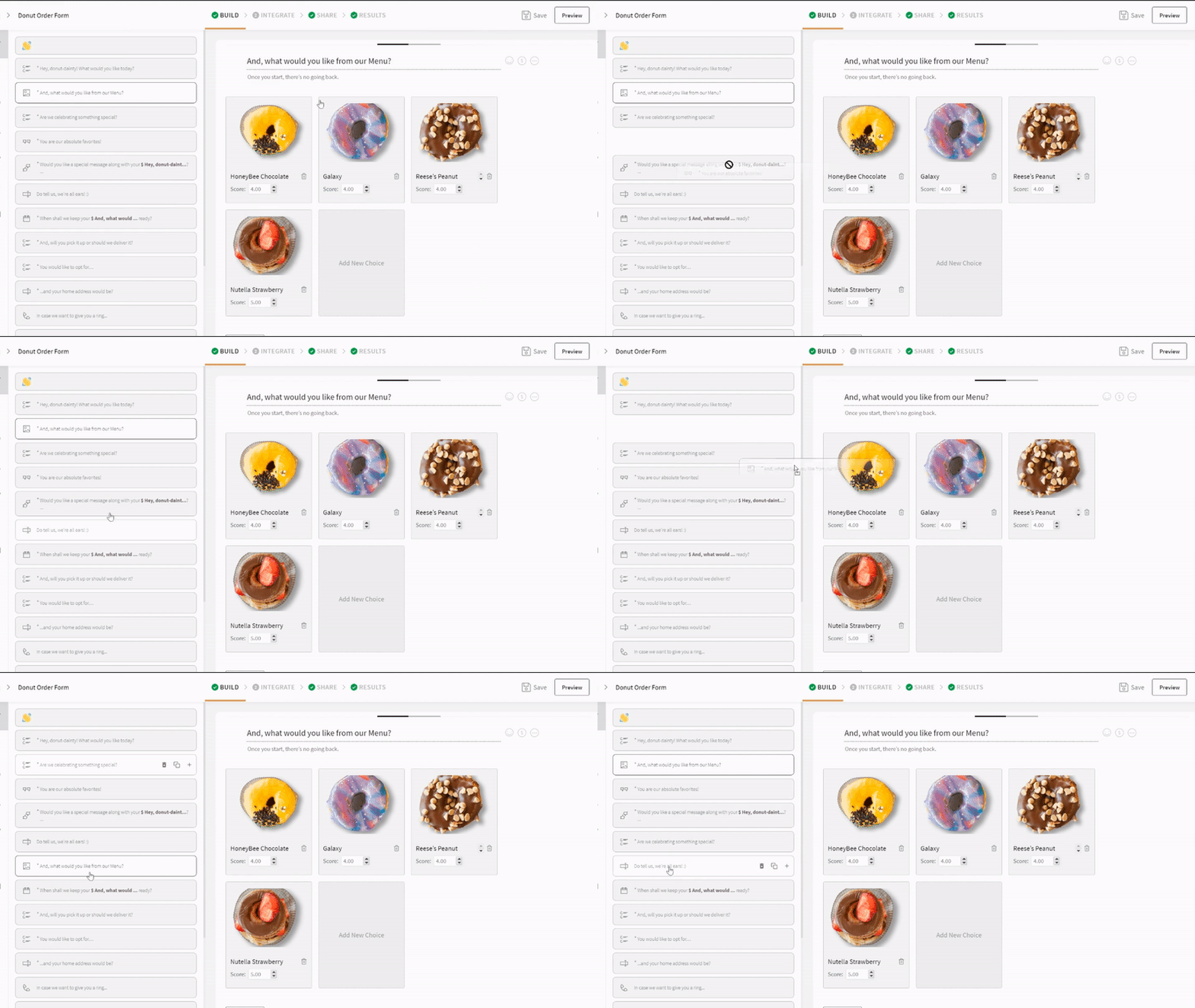
Survey templates are an effective tool for saving time and effort on survey design. Try our survey template library, easy-to-use UI and multiple share channels for 14 days absolutely free.
Start your free trial now.
As the survey creator, your job is to keep bias to a minimum for honest, thoughtful responses. So how do you do that? One way is to know how different types of biased survey questions work and take action to minimize them.
Question order bias comes in two forms:
1. The question order and sequence
The order of the questions in a survey impacts responses to other questions – especially if the first question is rather sensitive or specific.
For example, in this Cold War experiment, US respondents were surveyed on their attitudes to cross-border travel for American and Soviet reporters. The experiment found a significant question order effect.
In short, people were more open to admitting Soviet reporters into the US after answering a question about allowing American reporters into Soviet countries. But when the question order was switched, people were less likely to want Soviet reporters in the US (and vice versa).
2. The bias in questions when they are not randomized.
This happens in surveys where images are critical, like concept testing. This refers to improving a concept – a logo, product idea, ad campaign, etc. – by collecting feedback from your target audience.
Leading question bias is a type of cognitive bias that occurs when the wording of a question influences the answer. Basically, putting words in the respondent’s mouth. It is also called “leading statement bias” or “leading hypothesis bias.”
An example of leading question bias is when employees are asked, “What are your issues with the agency?” or when customers are asked, “How great is our service?”. Both questions include assumptions and emotional language. This is a huge no-no because if people feel they are being manipulated, it can lead to higher survey drop-off rates.
“How likely are you to recommend working with our current agency?”
“Please state your reasons.”
“How would you rate our service?”
Loaded questions are questions that are designed to elicit a specific response. They are often used in surveys to get the desired answer from the respondent.
In this regard, leading questions and loaded questions are similar. The difference tends to be in the answers. Loaded questions force respondents to answer in black and white, “yes” or “no”, which puts them on the defensive. Leading questions leave room for an open-ended reply.
For example, when you ask an employee, “How often do you take a break twice a day?” it should ideally be the follow-up to: “How many breaks do you take in a day?” But if the question isn’t relevant, you can use skip logic.

Like a double-barreled shotgun, double-barreled survey questions ask for two different pieces of information in one question. They are often used in surveys to save time but can lead to confusion and inaccurate data.
To spot a double-barreled question, look for ‘and’, ‘or’ or even a ‘?’. Here’s an example from a library survey: “When do you prefer to use the library? Which day do you prefer the most while visiting?“
Vague questions are a common problem in surveys. Unlike leading and loaded questions, they leave too much room for interpretation. In that case, you won’t get coherent results since the range of answers will vary wildly.
Here’s an example of a vague question: “Did you find this blog helpful?” One, it doesn’t tell you what the reader found helpful. Two, you may define helpful as “informative and fun,” but the reader may define it as “something that helps me get X done.”
“What were your key takeaways from this blog?”
Absolute questions are problematic because they restrict the respondent’s answer options to Yes/No or ‘True/False. This forces the respondent to pick an option that might not reflect their honest opinion. That is how absolute question bias skews your data.
Absolute questions also include absolute terms, like all, none, must, every, always, just, only, never…you get the drift.

Think of every user agreement you’ve ever read. They’re long, tedious, and make you want to hit ‘Agree’ straightaway! In surveys, that is known as the acquiescence or agreement bias.
Acquiescence bias happens when a respondent loses interest in the survey. So they zip through it and mostly choose positive responses in the process. This can give the impression that everything’s going well.
We’ve talked about seven types of biased survey questions. We’ve also shared our top tactics for minimizing them. But if you want to know more about writing better questions, here’s a guide on writing survey questions that will give you the exact responses you’re looking for.
Happy surveying!


Thousands of brands trust SurveySparrow to turn feedback into growth. Try it free today!

Best Of
9 MINUTES
22 June 2021

Best Of
11 MINUTES
25 February 2020

Best Of
9 MINUTES
15 April 2020

Best Of
12 MINUTES
10 May 2022
14-day free trial • Cancel Anytime • No Credit Card Required • No Strings Attached


