General
The Future of AI in Marketing Automation: Key Trends and Strategies

TRUSTED BY BEST-IN-CLASS BRANDS



Ever wondered what the future of AI in marketing automation holds? Will it transform how we interact with our audience and spur business expansion?
Imagine a world where marketing campaigns anticipate your every need, personalized messages reach you at just the right moment, and customer experiences are tailored to perfection. Is it the stuff of dreams or a glimpse into the future of marketing automation? The answer lies in the revolutionary advancements of Artificial Intelligence (AI). As AI continues to reshape industries, its integration with marketing automation is opening up a realm of possibilities.
In this blog, we’ll delve into the latest trends and strategies that are reshaping the marketing landscape. From AI-driven personalization to machine learning and intelligent automation, we’ll explore the practical applications and benefits of incorporating AI into your marketing automation efforts.
AI-Driven Personalization for Enhanced Customer Experiences
Close your eyes for a moment and envision a marketing journey that unfolds seamlessly, adapting to your preferences and needs at every turn. That’s the magic of AI-driven personalization, where technology becomes your personal marketing assistant, working tirelessly behind the scenes to create a truly tailored experience just for you. But what exactly does AI-driven personalization entail?
Let’s delve into some key aspects:
1. Dynamic Website Personalization
- AI-powered personalization enables businesses to create dynamic website experiences tailored to each visitor.
- By analyzing real-time data and customer behavior, AI algorithms can deliver personalized content, product recommendations, and offers that align with individual preferences.
- For example, a clothing retailer can showcase relevant products based on a customer’s browsing history and previous purchases, increasing the likelihood of conversion and customer satisfaction.
2. Email Campaign Personalization
- Email marketing remains a powerful tool for engaging customers, and AI takes it to the next level. With AI-driven personalization, marketers can create highly targeted and personalized email campaigns that resonate with recipients.
- By segmenting the audience based on their interests, behaviors, and demographics, AI algorithms can generate personalized subject lines, content, and product recommendations that capture attention and drive engagement.
- The result? Improved open rates, click-through rates, and conversions.
3. Predictive Content Recommendations
- AI-powered personalization goes beyond simple segmentation. It uses predictive analytics to anticipate customer preferences and behavior, enabling businesses to provide proactive content recommendations.
- By analyzing historical data and patterns, AI algorithms can predict the type of content that will most likely resonate with each customer.
- This helps marketers deliver the right content at the right time, increasing engagement and creating a more personalized experience.
4. Chatbot Personalization
- Chatbots have become an integral part of customer service, and AI-powered chatbots take it a step further.
- These intelligent virtual assistants can understand and respond to customer inquiries in a personalized manner.
- By leveraging natural language processing and machine learning, AI chatbots can tailor responses based on customer history, preferences, and previous interactions. This not only enhances customer satisfaction but also saves valuable time and resources for businesses.
And speaking of automation, if you’re looking for a powerful tool to enhance your survey and feedback processes, allow me to introduce you to SurveySparrow. By integrating it into your marketing automation strategy, you can supercharge your personalization efforts and deliver experiences that truly connect with your audience. Give it a try if you are interested.
Machine Learning for Data-Driven Decision Making
Data is the secret fuel that powers AI in marketing automation. Machine learning algorithms analyze vast amounts of data to uncover patterns, trends, and insights that can inform data-driven decision making. By integrating machine learning capabilities into your marketing automation strategy, you can optimize your campaigns, identify high-value customer segments, and personalize your messaging for maximum impact.
Intense huh? Here’s a visual representation of the machine learning process in marketing automation.
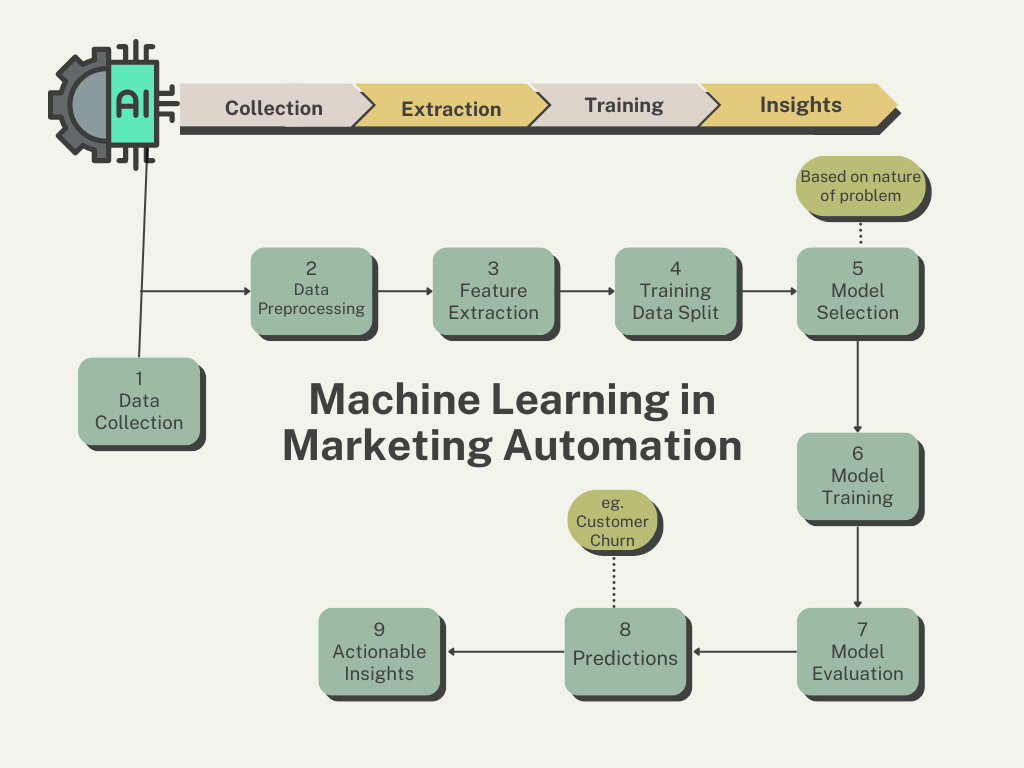
Now, let’s see how AI helps:
#1 Data Collection
Data from diverse sources such as customer interactions, website analytics, and social media engagement is collected. This data serves as the fuel for subsequent AI-driven processes.
#2 Data Preprocessing
The collected data undergoes preprocessing to ensure its quality and reliability. This step involves tasks such as data cleaning, handling missing values, and transforming data into a suitable format for analysis.
#3 Feature Extraction
Relevant features are extracted from the preprocessed data. These features represent key attributes or variables that carry valuable information for analysis. Eg: customer demographics, purchase history, browsing behavior, and sentiment analysis from social media.
#4 Training Data Split
To develop accurate machine learning models, the dataset is split into two parts: the training set and the testing/validation set. The training set is used to train the models, while the testing/validation set is used to evaluate their performance.
#5 AI Integration
In this pivotal stage, artificial intelligence is seamlessly integrated into the machine learning process. AI algorithms, such as natural language processing (NLP), computer vision, and deep learning, augment the capabilities of machine learning models to derive deeper insights from the data.
#6 Model Training
Machine learning models, enhanced by AI techniques, are trained using the preprocessed and feature-engineered data. These models learn from patterns, correlations, and trends within the data to make accurate predictions or generate meaningful recommendations.
#7 Model Evaluation
Trained models are evaluated using testing/validation datasets to measure their performance and assess their ability to generalize to unseen data. AI-driven evaluation techniques, such as automated model selection and hyperparameter tuning, contribute to optimizing model performance.
#8 Predictions/Recommendations
The trained models, powered by AI, are capable of making predictions or generating personalized recommendations. These predictions can encompass customer behavior, product preferences, market trends, and other valuable insights that inform marketing automation strategies.
#9 Actionable Insights
The predictions and recommendations generated by AI-infused machine learning models provide actionable insights for marketing automation. These insights enable businesses to optimize campaigns, personalize customer experiences, target specific segments, and improve overall marketing performance.
Intelligent Automation for Streamlined Workflows
Let’s face it. With a never ending to do list and a cloud of pressure looming over you, AI emerges as a savior. With AI powered automation, you can hand over repetitive tasks to your automated assistant and focus on what is important—strategy and creativity.
Why is Intelligent automation a game changer?
Well, with it, you can:
- Say goodbye to human error and hello to consistency in your marketing activities.
- Save precious time by automating manual tasks, giving you room to flex your creative muscles.
- Delight your customers with timely and relevant content that’s tailored to their needs.
- Boost your campaign’s performance and maximize your return on investment (ROI).
Imagine you’re an online retailer looking to provide personalized product recommendations to each customer. With the power of AI in marketing automation, you can analyze customer data and browsing history to deliver tailored recommendations in real-time.
The result? A delightful shopping experience that boosts sales and keeps customers coming back for more.
Top Trends in AI for Marketing Automation
1. Content Creation:
With advanced features like NLP (Natural language Processing), AI can create quality content. Machine learning algorithms enable it to fetch all the possible words and phrases to create a piece that resonates with the audience.
2. Hyper-Personalization:
What if you could interact with your audience as if you knew them inside out? It sounds like a perfect dream, right? Well, it is possible with AI. With advanced algorithms, machine learning can analyze chunks of data, including preferences, behaviors, and demographics, to deliver personalized content, recommendations, and offers.
3. Advanced Chat Bots:
From lead generation to product recommendations and customer service, AI powered chatbots can be used to enhance the customer experience. The conversational interface lets it communicate with humans, like humans.
Pros and Cons
Advantages of AI for Marketing Automation
- Enhances efficiency and productivity: AI-powered marketing automation tools can handle repetitive tasks, data analysis, and campaign optimization with lightning speed and precision.
- Saves costs: By automating repetitive tasks, you can easily cut down on unwanted expenses.
- AI-powered predictive analytics: Marketers can analyze and anticipate customer needs, behaviors, and preferences.
Disadvantages of AI for Marketing Automation
- Over-reliance on Algorithms: Even though AI can deliver top notch content, there will be many loopholes. Over-reliance on algorithms without human oversight can lead to unforeseen losses.
- Generalized content: Let’s face it, readers will get bored of consuming the same kind of content that prevails on the internet. Original content is not really AI’s strong suit.
- Privacy is at stake: It is possible for confidential information to leak if you share sensitive content. Though the privacy settings ensure data protection, we can’t be completely certain.
Conclusion
With AI-powered technologies like machine learning and predictive analytics, businesses can gain valuable insights, optimize campaigns, and deliver personalized experiences that resonate with customers. However, it’s important to navigate the challenges of data privacy, ethics, and finding the right balance between automation and human touch. By staying informed, adapting to consumer expectations, and leveraging AI strategically, business can pave the way for growth and exceptional customer experiences in the digital era.
Before we wrap up, let me ask you the most important question. Are you ready to utilize the full potential of AI to elevate your marketing strategies? If yes, get onboard and embark on this innovative journey with AI for marketing automation. Now that you know what to do, what not to do, what to expect, and all the viable possibilities, you will be able to make insightful decisions.
Also, don’t forget to try SurveySparrow for free today!